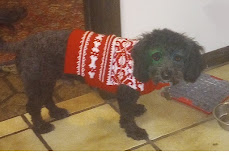
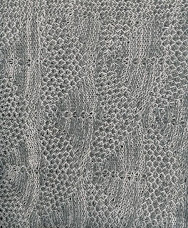
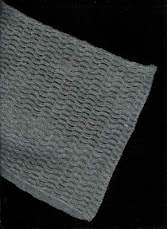
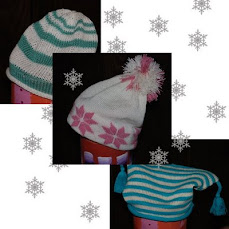
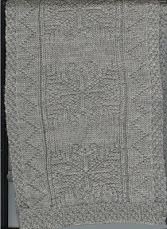
New front teeth almost all the way in and the
new scarf. My son-in-law said it was 90 degrees when the scarf arrived and he wore it for 2 days straight. It's fun to knit for someone who appreciates your work!!!
machine knitting midgauge standard bulky machknit knit machine-knit patterns
Friday, July 20, 2018
Tuesday, June 26, 2018
Lots Accomplished
Our machine knitting guild had an "in-town knit camp" this past weekend. There were 11 of us in a nice room usually used by quilters at a quilt shop. We all like to go home to our own beds, hence the "in-town" aspect. My personal goal was to use up some yarn. I did manage to get 13 hats done. Not as much yarn used up as you might think. Eating the fantastic potlucks took up some time, don't you know. Lots of laughs too. I used the LK 150 for all. (Click picture on right side here for pattern .)
Here's a good tip. A guild member's technique for hanging the hem made quick work of it. He pulls out to d position every other needle, knits one row with main yarn, hangs the metal cast on comb that has the wicked teeth, backwards. (no waste yarn or ravel cord.) Then he brings the alternate needles to work and knits twice the length of the hem. Then he brings out every other needle again, puts a weighted metal dowel onto (on top of, across) the knitting and brings up the beginning stitches and hangs all stitches in one fell swoop. When you tip the cast on bar, the stitches slip onto the needles you have pulled out. Remove cast on comb. It requires a little practice, but I love how much time it saves. It is NOT as pretty as a regular hung hem, but I doubt kids are going to check out the inside of the hat. Another advantage is that the dowel weights the knitting evenly for the duration. Try it. You may agree. You can purchase a metal rod at the hardware store for cheap. It is nearly impossible to do this if a ribber is attached because you can't get to the bottom of the knitting to grab the cast on comb without dumping the stitches prematurely. Just a warning.
I also knit a Gryffindor scarf for my grandson. He's currently a fan of Harry Potter. It's 7 inches across doubled and seamed up the back, about 5 1/2 feet long. Gauge was about 5 st and 6 r to the inch. I didn't write it down, but I think it was 70 st by 280 rows, each stripe was 20 rows. T 9. Usually I'm religious about writing these things down, but I guess I thought I'd never knit another one. I used less than 2 skeins of sport weight hand knitting yarn, 100 gr each and I bought 4. O dear, more charity hats with U of M colors.
I found a free machine embroidery patch that is the Gryffindor shield and did that at home ahead of time, glued it on with a hot glue gun. Only problem was that the guy who designed it spelled Griffindor wrong. So I had to use some emb software to change it to a "Y". Hard to work on someone else's design but I managed ok. Not perfect, but ok. Since grandson lives in CA, it's just going to be part of his Harry costume, not really utilitarian. Too hot. I think he'll like it, though.
When he was here a few weeks ago I gave him the robe, glasses and the rep tie. Pretty cute. So now he should be all set.
Here's a good tip. A guild member's technique for hanging the hem made quick work of it. He pulls out to d position every other needle, knits one row with main yarn, hangs the metal cast on comb that has the wicked teeth, backwards. (no waste yarn or ravel cord.) Then he brings the alternate needles to work and knits twice the length of the hem. Then he brings out every other needle again, puts a weighted metal dowel onto (on top of, across) the knitting and brings up the beginning stitches and hangs all stitches in one fell swoop. When you tip the cast on bar, the stitches slip onto the needles you have pulled out. Remove cast on comb. It requires a little practice, but I love how much time it saves. It is NOT as pretty as a regular hung hem, but I doubt kids are going to check out the inside of the hat. Another advantage is that the dowel weights the knitting evenly for the duration. Try it. You may agree. You can purchase a metal rod at the hardware store for cheap. It is nearly impossible to do this if a ribber is attached because you can't get to the bottom of the knitting to grab the cast on comb without dumping the stitches prematurely. Just a warning.
I also knit a Gryffindor scarf for my grandson. He's currently a fan of Harry Potter. It's 7 inches across doubled and seamed up the back, about 5 1/2 feet long. Gauge was about 5 st and 6 r to the inch. I didn't write it down, but I think it was 70 st by 280 rows, each stripe was 20 rows. T 9. Usually I'm religious about writing these things down, but I guess I thought I'd never knit another one. I used less than 2 skeins of sport weight hand knitting yarn, 100 gr each and I bought 4. O dear, more charity hats with U of M colors.
I found a free machine embroidery patch that is the Gryffindor shield and did that at home ahead of time, glued it on with a hot glue gun. Only problem was that the guy who designed it spelled Griffindor wrong. So I had to use some emb software to change it to a "Y". Hard to work on someone else's design but I managed ok. Not perfect, but ok. Since grandson lives in CA, it's just going to be part of his Harry costume, not really utilitarian. Too hot. I think he'll like it, though.
When he was here a few weeks ago I gave him the robe, glasses and the rep tie. Pretty cute. So now he should be all set.
Thursday, March 29, 2018
Baby Pants to accompany Baby Ballet Sweater
This might be turning out to be a once in a year submission. Don't you hate it when people do that? I'll try to be better, but no promises.
Today I'm posting a pattern that you can make to accompany the Baby Ballet sweater. The sweater turned out to be popular with beginning knitters. It didn't require a lot of fancy footwork and when the directions were followed, you ended up with a nice product. That pattern can be accessed by clicking on the picture on the right side of the blog. To complete an outfit, you can knit these pants also.
Machine: kx350,
LK 150, Silver Reed 860 MIDGAUGE MACHINE
Yarn: Sport to lt.worsted, acrylic. If you want to use cotton, knit it into a large rectangle, wash and dry to pre-shrink and wind again.
Other: 19 (20) inches of one inch
wide elastic (allowing for seaming into a circle)
Gauge: T 5 ----5 stitches and 6 rows to 1 inch
Finished sizes: 6 (12) months. Width at seamed tummy area 24 (26) inches
around. Length after cuff and before
waistband 17 (18) inches, width of ankle area 9.2 (10) inches, length after
cuff to crotch 10 (10.5) inches, length from crotch to top before hem 7 (7.5)
inches. If you think you need longer pants for a particular baby, you could
knit more rows on the straight knitting between the crotch and waistband and/or
after the increases and before the crotch bind off.
Directions: Knit two legs the same directions 1 through 3.
1 Hem. Ewrap Cast on 46 (50 ) stitches every other
needle, leaving a long tail for seaming. Hang your cast on comb and some weights. Leave out of work N out of work for the length of the cuff. Knit 18 (18) rows at T 2. Take the cast on comb and weights so you can hang a hem on the empty needles. (Using your one prong tool, hang the beginning stitches onto the empty needles across the bed.)
2 Leg. Hang 2 claw weights again. Bring all needles to work, change to T 5. Start the chart for the size needed. See note below if you need help reading this
kind of chart.
3 Waistband. [Hint: If you find it difficult to see which loop to hang, when you start the waistband, run a different colored yarn along with the main yarn for just this first row of the waistband. To hang, look for the horizontal loops that have this extra color. Remove the extra yarn later.] After you complete the length of the leg indicated by
the chart, transfer every other needle to neighbor and put the emptied needles
out of work for the length of the waistband.
T2 knit 20 rows. Hang a hem from
the loops formed when you switched to every other needle and bind off really loosely. Take a ruler or a hand knitting needle and pull out the mock hem stitches to set
them. Now knit the other leg.
4 Seam. Seam the inner leg (including cuff) with a
mattress stitch, both legs. Match crotch
seams and sew up one tummy seam then the butt seam, including waistband except
for back side of one side of the waistband. You need this open to be able to insert the elastic.
5 Elastic waistband. Don’t
cut yarn tail yet. Insert elastic with a large safety pin, overlap by ½ inch when you get it all the way around and remove safety pin. Sew securely. Finish seaming the knitted back side of waist band with
yarn tail. Hide any yarn tails
remaining.
How to read the DAK-style chart:
Example following the size 6 months. For this particular pattern, first you knit the cuff. Then, 0(46) means you
haven’t knit any rows yet of the leg. Here you'll already have every other needle across left 23 to right 23. Once the cuff is completed, all needles are brought into work. Begin following the shaping directions. Another
Example 31:+1S 4
X 7 means at row counter 31, increase
1 stitch every 4 rows 7 times. (For this
pattern, do a full fashioned increase)
so you would increase both sides one stitch on row counter 31, 35, 39,
43, 47, 51, 55. When the piece is a
mirror image left to right, I just read the one side. If you want, you can write down the row
numbers and check off the decreases or increases on the pattern to help you
remember where you are. Crotch numbers
(rows 59 and 60) should be done opposite of what the chart says because for odd
numbers your carriage is on the left and for even numbers it’s on the
right. You need the carriage on the same
side as you are binding off. I don’t
know why my DAK program does it that way.
Six months:
12 months:
The directions for a full fashioned increase are in the sweater pattern. Do this so that the edges are easy to seam.
Pretty easy, yes? This is a good pattern for charity or a gift. Sell the finished product if you are so inclined. Hope you find this as satisfying as the sweater.
Friday, July 28, 2017
Wow, it's been just over a year since my last post. No excuses, just lazy.
I thought I would share with you my latest "quicky"/"quirky" knit. Hope you can use.
A project that
uses up scraps of fabric and small amounts of yarn and is quick and is useful
and can get you out of a knitting funk!!!
What could be better? I have a
lot of T shirts and camisoles that I’d prefer to hang up rather than fold and
put in a drawer. They always fall off
regular hangers. I don’t hang my
sweaters, but these are also good for jackets where you don’t want a hanger
mark on the shoulders of the garment.
First, wrap fabric
around the hanger, as fat as you want and fasten it with safety pins where
necessary, to be removed later as you progress sewing along the seam. I used safety pins so that the pins wouldn’t
be forgotten/left into the project/stick me.
Depending on the fabric you use, you may want to go around several times
in one place before moving over. Start
and end by leaving ½” of wrapped fabric hanging off so the end of the hanger
gets covered.
Fold the piece in
half to find the middle of the length and the middle of the width and slip it
over the hanger’s metal loop neck.
Stretch the knitting as much as needed to cover the ends. Cinch up the stitches that were the end of
your knitting and begin sewing shut. For
the other end of the hanger, take the 10” thread and sew in and out to be able
to gather the stitches closed. Take a
few stitches and secure. Using the 20”
tail, continue seaming it up doing a mattress stitch.
The knitting is very forgiving, so if the
knitted piece is too large, just fold under one edge and stretch less. If really too short and not wide enough, try
again. The seam runs along the underside
of the hanger.
รงunderside. Hide your ends and voila, a nifty thing to
add to your closet.
I thought I would share with you my latest "quicky"/"quirky" knit. Hope you can use.
Knitted
Covers for Wooden Hangers
I decided to
take a tip from friend Donna V and make covered hangers. She does a lot of
craft fairs and when she knits a beautiful shawl, she makes a matching padded
hanger for display and to go along with it.
Hers are no doubt more elegant than mine.
This is a
long explanation for a quick and easy project.
What you
need:
1. Wooden hangers (without the bar for
pants) are preferred. I have also sawed
off the bar if it’s wooden, discarded the bar and used the hangers that way too.
(The coverings prevent any rawness to show or be felt.)
2. I have purchased many wooden hangers from a local thrift
store for 10 to 25 cents each. You might
be able to find them cheaper. Also had some in my own closets. The only ones that I couldn’t seem to saw off
had an extra metal bar that resisted my attempts to remove it. Some of the ones I have purchased were almost
rusty on the hook so I had to sand them.
You can also use heavy duty
plastic hangers, but they are less desirable because they break. And then your efforts are wasted.
3. Fabric scraps, any color, preferably cotton so no
insect critters are attracted. I ripped
or cut the scraps into 1 ½ to 3” strips, any length. You can also use leftover
batting, felt, polar fleece, etc. It all ends up being cushy.

4. Knitting machine, any gauge, and yarn leftovers,
preferably acrylic or cotton, again so that no insect critters are attracted.
Knit the
cover on your knitting machine. I used
the purl side of the every other stitch tuck dishcloth pattern. On the 970 standard gauge it’s #45 and I
doubled the length to get more texture.
You’ll have to knit one, try it on your hanger and then adjust. I did some in stripes and some plain. I suppose you could do any other stitch
design---this was just easy and fast.
On the
standard gauge, using the tuck pattern, my covers were 40 stitches, T 7, 8, 9
or 10 depending on the thickness of the yarn and about 240 to 270 rows. For the ends, I ewrapped on leaving a 10 inch
tail and at the other end took off the stitches with a double eyed transfer
needle, also leaving a tail of about 20 inches.
Too large is not a problem, but too small you might want to adjust and
start again.
If using a
midgauge or bulky machine you’ll have to experiment with your stitches and
rows, but the construction will be basically the same. For the midgauge calculate about 7/8 of the
measurements here and ½ for the bulky. You
might be wondering why I didn’t cast on and end with every other needle. It works, but the coverage of the fabric
underneath isn’t as good in my opinion.
You can, of course, do whatever you want. I also tried to use colors of yarn that would
cover up the fabric underneath. You
could also tie a little bow where the neck meets the hanger, wrap yarn around
the hook or add a little sachet to make
it fancier.
I confess, I
have made 60 of them so far. I plan to
give some away to family for extra Christmas prezzies next holiday….. I’m quite enamored with them and have most of
my closet converted over to these.
Labels:
Bulky,
Free machine knitting pattern,
midgauge,
standard
Saturday, July 16, 2016
Using DAK to Create a Quilt
I have been looking at the quilts that have offset crosses or pluses and want to make a baby quilt using this pattern. I'm a little challenged where patterns using geometrics are concerned so thought I'd use DAK to help me out.
I knew I wanted a quilt that was about 36" x 48". DAK presents each stitch as a rectangle so I pretended they were square. I don't know if you can change that. So I needed squares that measure
3 1/2" inches to allow for the 1/4" seams and that determined how many "stitches" I would fill in.
12 squares wide and 15 squares long were what was needed counting the borders. I left all the default colors in the palette in place so I'd have enough to choose from to make the pluses stand out. Depending on the pattern being designed, a person could choose just those colors to match the fabric that would be used.
This might sound elementary to you or maybe even stupid (!) but it helped me see where the squares need to be placed to get the off- set pluses. Here's what I got:
DAK wouldn't let me print out the design as is because it was too many colors for fairisle. But by going Options, knitting method, intarsia and saving it that way, DAK would print. However, I needed to use the single tool to enlarge the pattern to 200% to make it useful. This is printable this way. One nice thing is that DAK numbers the columns. Another help in placing your plus blocks. After the design is printed, you could number the blocks to match the fabric being used.
The picture shown here was a screen shot of the design in DAK and copied to the Paint program. Any image processing program could be used. You can also copy the design to the clipboard right from DAK and paste it. The nice thing about Paint is that it is simple to use, most all pc's have the program and you can resize the picture as large as you need it.
or include the border patches this way?
I knew I wanted a quilt that was about 36" x 48". DAK presents each stitch as a rectangle so I pretended they were square. I don't know if you can change that. So I needed squares that measure
3 1/2" inches to allow for the 1/4" seams and that determined how many "stitches" I would fill in.
12 squares wide and 15 squares long were what was needed counting the borders. I left all the default colors in the palette in place so I'd have enough to choose from to make the pluses stand out. Depending on the pattern being designed, a person could choose just those colors to match the fabric that would be used.
This might sound elementary to you or maybe even stupid (!) but it helped me see where the squares need to be placed to get the off- set pluses. Here's what I got:
DAK wouldn't let me print out the design as is because it was too many colors for fairisle. But by going Options, knitting method, intarsia and saving it that way, DAK would print. However, I needed to use the single tool to enlarge the pattern to 200% to make it useful. This is printable this way. One nice thing is that DAK numbers the columns. Another help in placing your plus blocks. After the design is printed, you could number the blocks to match the fabric being used.
The picture shown here was a screen shot of the design in DAK and copied to the Paint program. Any image processing program could be used. You can also copy the design to the clipboard right from DAK and paste it. The nice thing about Paint is that it is simple to use, most all pc's have the program and you can resize the picture as large as you need it.
From this point, a person would figure out the 9 patch blocks and draw them in. It seems to me that there's no easy way to do this... but then again, maybe it's my little "problem" rearing its head again. You could do your 9 patches this way:
just pluses or horizontal strips???
I guess I should go hunting on YouTube and find out the best way to do this. At least now I know what the crosses are supposed to look like. Some quilt patterns are just not going to work, though.
Especially those with half square triangles. But lots will work. Maybe it can help you too.
Sunday, May 22, 2016
Prayer Shawl
A very generous friend, Bonnie in Vermont, sent our guild (the Machine Knitting Guild of Minnesota) some luscious yarn. Lots of luscious yarn. She's downsizing and we are upsizing! I wanted to show guild members what one single cone would produce. This one was from Webs. called Crystal and is made of acrylic and nylon. 2000 yards. There were many cones of this kind of yarn and sometimes people can't think of what to do with it since it is quite thin.
I knit a tuck stitch prayer shawl with a built in tuck pattern, 144 stitches x 900 rows. (Yup, not a typo.) Then I did a kind of twirly edging and ended up with about 2 yards of yarn left!!!
It's about 7 feet long by 24" wide. Enough, I think, to wrap around shoulders. If you want a little more specific directions, here goes. And, just about any yarn goes.
This one done on a Standard gauge machine but the idea could be adapted for any gauge machine.
Tension 7 (or whatever works with your yarn) Start with waste yarn and knit a few rows to get going over 144 needles.
Ewrap cast on over these 144 needles with main yarn. RC 000. Knit 10 plain rows. Set up machine for tuck using any tuck pattern built in or a punch card or hand manipulate if you are patient and persistent. Nah, that's just crazy. Knit to RC 890, turn off tuck, knit 10 rows plain and bind off using your favorite bind off.
EDGING: Try it on a swatch of the same type of yarn to see if you need to skip some shawl stitches as you go around, especially on the long sides. Skipping some prevents a ruffle. Unless you want a ruffle, that is.
Begin at the far right of your needle bed. With the wrong side facing you=== for tuck this would be the knit side==== starting in the middle of one side of the shawl, pick up and hang 3 edge stitches of the shawl with your 3 prong tool. Don't just pick up a loop, but a little more to make it substantial. Knit 6 rows. No need for weights because the shawl weighs it down. Pick up and hang 3 stitches to the left of those in work, K6 rows. *Pick up and hang 3 more stitches to the left of those in work, hang the far right 3 stitches onto the 3 stitches to the left of them. (There will be 2 stitches on each of those 3 right needles.) 6 stitches in work now. Push emptied needles out of work each time. Knit 6 rows.* Repeat from * to *. When you get to a corner, knit 8 rows rather than the 6 to get around the corner without a pucker. At the end, bind off and join to the beginning stitches, leaving a 12" yarn tail. Tidy up by sewing by hand with the tail of the main yarn.
Note that you'll be traveling down the bed, so you will most likely have to take off stitches and move them back to the right a few times. ok, quite a few times. I just use a double eyed needle to put the stitches on and move them.
This edging has lots of uses, baby blankets for one, and looks ok from both sides. It tames the edges so they don't curl. Don't know where I got it or what it's called.
I steamed the shawl quite aggressively and it turned out pretty nice. I'll be donating it to a local nursing home. Red is cheerful, don't you think?
Thank you yarn angel Bonnie---your yarn will be put to good use!
Wednesday, April 27, 2016
Norwegian Sweaters
Here's a picture of some of the guild members who took my Norwegian sweater class. Actually, another gal and I taught it together over a period of 3 months. We systematically took one step at a time. None of the class participants had knit fairisle before, much less a whole sweater. I'm proud of them!!! They all did the same basic pattern with slight modifications. All were done on the standard gauge machine. Plans to knit more are in the works.
Subscribe to:
Posts (Atom)