machine knitting midgauge standard bulky machknit knit machine-knit patterns

Showing posts with label DesignaKnit - DAK. Show all posts

Monday, June 14, 2021

Premie Standard Gauge Machine Knit Ballet Sweater


(Midgauge Baby Ballet can be found on the right side of the blog.  This one is a little shorter.)

 I'm in the process of knitting baby stuff to donate.  This is a super easy one for premies and if it weren't for all the yarn ends would go super fast.  Some suggestions for those pesky things below.

Skill Level:  Beginner 

Machine:  Standard 4.5 mm gauge

                        No ribber needed

Yarn:  Any that knits close to gauge.  My yarn is pretty skinny.

Gauge:  8 stitches and 12 rows to one inch at T7                                                                                                                

            If you want to knit this but your yarn obtains a different gauge, you can do the math.  First, knit a gauge swatch with your yarn.

            Formula:  Pattern’s rows or stitches and DIVIDE them by this pattern’s gauge, then take this figure TIMES the NEW gauge you obtained    (do the same for stitches and rows)


            EXAMPLE

            stitches in the pattern back 44 divided by 8 stitches per inch =5.5

            your gauge ex 4st to an inch x 5.5 = 22 st

            So instead of casting on 44 st, cast on 22

In some cases you will want to round up or down. For increases and decreases, look at the end of the piece and spread out increases or decreases to get to the correct amount.  Fairly easy on this tiny garment, a little trickier on large ones.


Finished size (Just one size)  width of back 5.5”, length  4.5”, sleeve 3.0”  (can be rolled up to make a  little cuff) 


Here are the DAK schematics for the pattern:


            (make one, reverse one)


This is a Designaknit produced pattern.  How to read:

The format is Row # --Decrease or increase so many stitches --every so many rows --So many times.

Example:  On the front, on row 28, decrease one stitch every two rows twice, so you decrease one stitch on row 28, knit 2 rows and decrease again one stitch on row 30.  If it helps, you can write down the in-between row decreases.

Hints – Unfortunately there are a lot of ends to work in.  You can either wait until finishing and work them in or try to weave them in as you go by hanging the end over every other needle before you knit the row.  You can also save some ends by leaving a long one at the bottom of the piece to seam with.  RC stands for row count.

FF means full fashioned.  This is why the front edges don’t roll.  To decrease, move the 4th stitch from the edge to the 3rd, the move all 3 stitches in to fill the empty needle.  To increase, move 3 stitches out one needle, then take the purl bump on an adjacent stitch and hang it on the empty needle so that there is no hole.

DIRECTIONS IN WORDS

*****For all pieces, do the 4 row rolled hem at a tighter tension (T3) then change to T7 and RC000 to start the schematic.*****

Back

With waste yarn, cast on 44 stitches.  Knit several rows at looser tension.

With main yarn ewrap left to right.  Change to T 3.  Knit 4 rows (might be a little tight). 

RC 000 Change to T 7 and knit to RC  29.  Bind off 3 stitches,  knit one row.

On row 30 bind off 3 stitches.  Knit to RC 54.  Take off these stitches in 3 parts. Put all stitches in hold, machine to hold.

For the first shoulder take off 12 stitches on several rows of waste yarn.  Remove from machine.

Bind off the next 30 stitches, decreasing one stitch on the 10th and 20th needle. Remove from machine.

Take machine off hold and take off the last 12 stitches on several rows of waste yarn.  Remove from machine.


Fronts:  Make one and reverse one.

With waste yarn, cast on 42 stitches.  Knit several rows at looser tension.

With main yarn ewrap left to right.  Change to T 3.  Knit 4 rows (might be a little tight). 

RC 000 Change to T 7 and follow the schematics using full fashioned decreases.  On row 30 for right side and 29 for left side (next to carriage) bind off 3 stitches and continue with the other side ff decreases. Knit to RC 54 and take the 12 st off on waste yarn.

Sleeves

With waste yarn, cast on 28 stitches.  Knit several rows at looser tension.

With main yarn ewrap left to right.  Change to T 3.  Knit 4 rows (might be a little tight). 

RC 000 Change to T 7 and knit to RC  17. Increase ff  one stitch both sides.  Knit to RC 34.  Increase ff one stitch both sides.  You now have 32 stitches.  Knit to RC 35 and take off on several rows of waste yarn.

Finishing

Join the shoulder stitches.  Put your carriage on the left.  With the right side of the back piece facing you, hang one set of 12 shoulder stitches.  With the wrong side of one matching front, hang the 12 shoulder stitches. Pull  the needles out and push the knitting to the back so that the stitches knit off properly.  Knit one row and bind off.  (I like to bind off around gate pegs to get the bind offs even.)

Do the same for the other shoulder.


Join the sleeves.  Put your carriage on the left.  With the right side of one sleeve facing you, hang the 32 stitches.  If you hang 16 on the left of zero and 16 on the right, it’s easier to get the seam to come out right.  This is a little tricky.  With the wrong side of the sweater facing you, hang the shoulder seam at zero.  With a 3 prong tool to measure out nicely, pick up  whole stitches from the body.  Skip a stitch of the garment and hang the next 3 stitches.  Try really hard to stick your tool in the same ditch every time.   Looks wonky if you don’t.                                                             

Continue picking up until all sleeve stitches have been attached to the body.  Now take a ruler and measure from the bottom of the sweater to the underarm.  Over on the other side, begin hanging stitches at the same place so that the front and back are not off kilter.  Fill in the stitches until all sleeve stitches are loaded up.


Pull all needles out and push knitting back so that the stitches knit off properly.  Knit one row left to right and bind off.

Do the same on the other side.

TIES  -  You need 4

Pick up 3 stitches at a corner of the garment.  Hang a wt on the garment.  At T 6 Knit 60 rows.  If you want to knit an I cord, push in one part button and knit 120 rows.  Just knitting the tie plain causes it to roll and it’s not too distinguishable from an I cord and goes faster.  Bind off by putting the two outer stitches on the center, cut the yarn and pull through to bind off/ fasten off.

Make 3 more , one at each corner.

SEAM

Mattress stitch the sides and the sleeves.  Run in yarn ends. Wash in detergent that doesn’t have perfume.

Steam a little if you think it’s necessary.

Donate to your favorite hospital or charity.  Might want to put your donation in a plastic bag to keep it clean.


Now I need to come up with a quick boys' pattern.


Thursday, April 15, 2021

Machine Knit Cotton Hot Pads


I am on a mission to use up some of my huge cotton stash.  Have knit a lot of dishcloths, but thought it would be fun to be a little more creative---and make something useful.  I now have a cache of little gifts on hand.

Here’s how I have done them:

 *Used all cotton yarn and my standard gauge Brother 970 machine.  My designs are approx. a gauge of 7 st and 10 r to the inch, but it doesn’t matter. Mine end up to be between 7 and 9 inches wide by approximately the same height. You could use wool---haven’t tried because I am trying to use up the cotton.  You could also do these with a punch card machine or knit them plain.  But , where’s the fun in plain???

*Start with several rows of waste yarn with a quick cast on.  Engage the design with your electronics, then just knit not doing a permanent cast on with main yarn.  I tried to be sure to do the design so that the carriage ends at the right side when adding contrast yarn. The designs are knit in one longish rectangle.  Might want to switch between KC I and KC II for some rows so you don’t have a contrast yarn going all the way across the knitting for no good reason.  When the design is done, the bottom row is seamed to the top row.

* Some of your designs may have long floats.  Not to worry.  They add to the insulation factor.  I had no trouble with the stitches not conforming to one another or splitting between stitches, but if you do have this issue you can latch up the long float to a matching color. No one sees the inside.

* You may wonder why you need more rows in the middle of a design when both bottom and top halves are the same.  I found out the hard way that you need about 4 rows to go around the “bend” when you seam bottom to top or it’s off.  If you only want to do the bottom half of the design, that’s fine.  Just remember to do the same rows as the design and add 4 extra rows.  Example—the design is 86 rows.  Knit the 86, do 4 rows plain, knit 86 rows plain.

*Adding a loop in the corner is optional.  I did about 6 stitches x 50-60 rows, plain knitting since it curls like I cord anyway.  Looks nice if you hang the front corner with wrong side facing, knit the loop, then pick up stitches from the back side, knit a row and bind off.  When you seam the sides you can hide the purl bumps.

* To seam bottom to top, you have two options:

              -The Perfectionist option is to take the piece off on waste yarn when the design is complete, turn it so the right side is facing you, hang bottom to top stitches.  Then bind off. The seam will be on the inside and not show.

              -The quicker, easier way is to hang the beginning stitches onto the top stitches when the piece is complete, then bind off around the gate pegs.  You will have a seam on the right side.  I think it looks ok. On one I ran out of main yarn right when I needed ONE MORE ROW!  So I used the contrast yarn to bind off.  So one row was main and one contrast.  I actually liked it--- it created a decorative stitch.

* Options for insulation for the middle of the hot pad--- I have used layers of insulbright, >1 layer of flannel cotton fabric (laundered first),  knitted squares of cotton yarn I didn’t like, old cotton cut to size swatches, machine sewed around edges so they wouldn’t unravel, cotton quilting batting, old clean towels.  After completing the knitting, I turned it wrong side out, then tacked the lining to the outer in several places, so it wouldn’t shift.  I used regular matching cotton sewing thread. Doesn’t show if you take tiny stitches.  When you are sure the lining won’t shift, turn right side out.

 * Finally, remove waste yarn and mattress stitch the side seams by hand with right side showing.


I used patterns that I have had in DAK for ages, some are built-in patterns, some are purchased—lots of Dale of Norway patterns.

Some examples-----------Have knitted abt 15 so far.  Addictive. Can you tell I love Norwegian designs??? 


I plan to tell a recipient to hand wash cold, dry flat.  I don't want them (the hotpads) to shrink and pucker up. 😊

My absolute favorite is the rosemaling design.  It was a free chart on the Dale of Norway site.  I converted the chart to a DAK file.  If you would like to have it, write to me.  I don't know how to attach a file here with Blogger.  If someone knows how, would like to be enlightened.

Thursday, September 10, 2020

Educats and Edudogs

 Thank you for the interest in the Educat and Edudog blanket patterns.  They are available for purchase using PayPal for $10.00 each.  My label there is marsmachineknitting.  You need to have DAK (any version) and an electronic machine to download to.  I do also have a hand knitting version.

The blanket is lined as you go and the edges are bound with multi-color Icord. I have made mine with acrylic so they would be easily washable.  Any yarn that works with your machine is ok as long as the different colors are the same weight.  I think the blanket would be ok to do on a garter carriage for the front, although I personally don't have the patience.  The idea is like an "I spy" quilt where you have the child find the cat who is sad or the dog that looks like Harry Potter, etc.

If you wish to purchase, just email me with the address you'd like the pattern to be emailed to and I will send you an invoice.

Thanks again.  If questions, just email me.

Tuesday, November 12, 2019

Garter Carriage Running Again

I bought my garter carriage years and years ago.  Used it to make a few things, put it on the shelf and forgot about it.   Kind of dumb to let a piece of equipment go unused, right?  Judging from members of my mk guild, it's common to NOT use it.  People are a little intimidated.  So, not having used it for a good while,  I took a refresher class from Cindy Schmatz sponsored by our mk guild and got the thing going again.  It's an 89 version with a new motor.  She tells me it's exactly like the newer versions but will not cast on automatically like the newer models do.  I can e-wrap just fine.  So I'm happy about that.

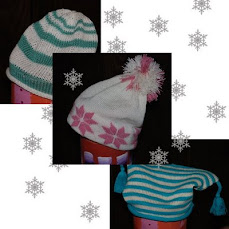
After a couple of mishaps (the main one not getting the carriage seated properly on the bed and it made a terrible clanking sound) I had some success.  The first thing I made was a baby hat.  Not so many stitches and rows, so it went faster than some other projects I hoped to make.  I shoulda/coulda wiped out the partial stars on the seam edges, but just wanted to see if it would chug along correctly.  No dropped stitches, feeling pretty good about things.  This baby hat wouldn't be warm enough in a Minnesota winter, but under the hood of a snowsuit would be ok. 
The rib looks ok (better than the picture shows) but I coulda/shoulda done that part with the ribber in 1/10 the time.  (Next time.)  The pattern is large snowflakes from a Brother G carriage book.

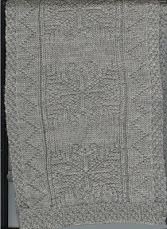
So- gaining some confidence, I programmed in another Brother G carriage pattern (073) adding 2 x 2 staggered edgings so it wouldn't roll.  I love this design.  My friend Sandy I. has made gorgeous baby blankets with it.  I made it long--- the length is the width worn--- and have worn it doubled since it wouldn't be super warm with a single layer using this particular yarn.  Since this cowl is 127 stitches and 372 rows it took maybe 16 hours to knit! I kitchenered the first row to the last but that's all I had to do other than hiding 2 yarn tails.   Here's a screen shot of the DAK pattern:

And a picture of the cowl folded double:

I have read that one shouldn't steam garter carriage stuff, so I didn't.  The picture doesn't show the texture as nice as it is in person,  Nice! I like it.

I have some  wool that would be warm enough with a single layer, so I changed the middle pattern to half.  Same Brother pattern.  Haven't knit it yet, but it's on my to-do list.  This is a screen shot of that pattern:

Being 68 stitches it will go a little faster.

Here's the original 24 st punch card pattern from Brother that I manipulated in DAK.

 If you have DAK and would like any of these patterns emailed to you, write to me and I'll send. 

It's getting cold here already so the extra winter wear is welcome.

Thursday, August 16, 2018

Zentangle and DAK

I hadn't heard of the term "zentangle" before and happened upon it by accident.  I thought many of the designs would make terrific scarves.  Maybe other things too, pillows?,but I started with scarves.  Here's how I did it:
1.  Google 'free zentangle' or 'free adult coloring book pages'.  There are so many, it's a little overwhelming.  You'll want black and white images that are not copyrighted.
2.  Pick an image you like and click on it to enlarge it.  Right click on it and choose Save image as.  Give it a name and save as a jpg or bmp.  I like to save to my desktop temporarily so it's easily accessible.
3. Open the Paint program (or other image processing program that you are familiar with).  Open the image.
4.  Paint will tell you how many pixels the image is in both directions.  You can resize the image in Paint or in DAK.  I find that resizing it first then putting into DAK works better.  Resize the image so that the width is compatible with the number of needles on your machine.  Write those numbers down. The original was 211 by 288 pixels.  By removing some of the width and doubling the length I got it to the size I wanted.
5.  Open DAK.  Now there are at least two ways you can convert this image to a knitting pattern.  I'll tell you the easiest way, in my opinion.  You can use either stitch designer or the graphics studio.  I used  stitch designer.  When you open the stitch designer part of the program, choose  File...new.  Specify the number of stitches and rows from #4.  Now go Edit...paste.  Voila, you have a stitch pattern.  You may need to fool around a little in terms of cleanup or deleting stitches and rows. 

The biggest obstacle is that black and white images aren't really black and white.  You typically will get lots of whites and lots of blacks.  Replace all the whites until you have just one shade of white.  Do the same with the blacks and grays.
Left click on the color you want and right click on the one you want to change, then click on the arrow marked in red. This is what I got when I converted the sunflower image.  Took a little time, but not too bad. Make sure you have one main and one contrast color.

I made a folder called Zentangle designs and saved all of the conversions in that folder.

It's fun to vary the colors keeping just two colors in work.  (You may want to do dbj, in which case you could do more than one color in a row.)  I chose to use fairisle, because on a scarf that I'm going to fold over and seam the long side, long floats won't matter.  The floats will be hidden inside the scarf.

Some designs are not rectangular and I wanted to add some length so in addition to doubling the image, I chose to knit several inches on both ends in plain stockinette.  I think it's fun to fool around in the program--- call me geeky, I guess. Some colors I thought were interesting:
If you try this and have some difficulties, write to me and I'll try to help.


Saturday, January 16, 2016

Bitten by the Gimp Bug

It's hard these days to figure out a gift for little kids that isn't plastic or something 80 million other kids have.  So, for Christmas, I converted some relatives' images to knit stitches and made pillows.  (They are sisters.)


I used Gimp (free download) and Designaknit to create the images.  I paid attention to the number of pixels for the width but forgot to calculate length for the Ruby pillow.  Geesh.  It turned out Ok, but it's one of those little regrets when all is said and done. Her dad says she's in love with it----slept with it for a week in her little tent----so I guess that's all that matters.


For info on how to use Gimp, I followed the instructions here:  http://wiki.evilmadscientist.com/Producing_a_stippled_image_with_Gimp  an excellent tutorial.
Then I used DAK's Graphic Studio to convert the picture to a knit design.  It's not too difficult, but I think I did mess around a bit to get the amount of shading that looked good.  I did fairisle because it's so fast and the floats are hidden inside the pillow.  The back of the pillow is just plain stockinette in the darker color, then seamed on 3 sides.   Once steamed lightly the stitches stay in place.  I'm sure if you like double bed jacquard, that would work just as nicely. Also, there are other programs that work for this, not just DAK.  Ravelry and Facebook have a lot of examples.


Kind of fun, pretty easy.  You might want to give it a try.

Thursday, May 28, 2015

Silly Machine Knit Project


Needing a mindless kind of project, I decided to knit a pencil bag for my grandson.  He's starting to draw a little so I bought regular pencils and colored pencils for him.  Now he has a place to store them.

On the standard machine, I used Mary Lou's Symphony yarn at tension 8.  Mine is 60 stitches wide by 61 rows tall.  The dimensions are approximately 9" wide by 4" tall.  The words are placed about in the center or maybe a little lower to allow for the zip at the top:
I knit the back first (61 rows) then the front.  I started with a crochet cast on and ended with a bind off around the gate pegs so the edges would be firm.  I used some polka dotted cotton and seamed it, seamed the knit part, then inserted the lining into the bag, sewed in the zipper.  The zipper pull has a little ribbon piece to more easily grab onto.

I have the Designaknit file if anyone wants it.  Just email me and I'll send it to you.  Any machine could be used.  If you don't have DAK, you could hand pull the contrasting color.

Friday, March 28, 2014

2002 Winter Olympics Salt Lake City Dale of Norway Sweater

I finally finished my nephew's Salt Lake City Dale of Norway cardigan.  I purchased the hand knitting pattern, scanned the graph into DAK and changed it into a stitch pattern.   I modified it to fit on my Brother 970 machine and changed the colors to just black and white, as requested.  I used Schuss Plus worsted wool, which was a real workout on the standard machine.  It made a wonderfully sturdy fabric, though, and will be like a jacket for him.  For the first time, I used a full needle rib for the buttonhole and button plackets and was really pleased with how much body they had compared to the 1x1 ribbing.  Don't know why I hadn't done that before.

Whew, am I glad to get that sweater done.  From request to completion was about 3 years.  Knitting time about 2 weeks.  He promised a picture of himself wearing it, but that is yet to be forthcoming.  I think it will be a while before I knit another one.  Too much concentration and too much work!  I think over the years I have knit 32 of these Norwegian sweaters for family members.    But anyway, with that promise fulfilled, I can move on to other things.

Tuesday, February 25, 2014

Tuck Baby Blanket

I may have mentioned before that my favorite charity to knit for is the Minnesota Visiting Nurses Association.  They help new mothers and they like to bring a little gift along with them when they visit.  An easy project to knit for charity is a tuck baby blanket.  If you have DesignaKnit, make your design about 186 to 190 stitches wide x 450 to 460 rows long.  Put a 1 x 1 border on the bottom, left and right and the top.  Any tuck pattern will work in the middle of the blanket.  You may need to adjust the number of stitches so that you get even repeats across.  This one uses squares, both single and double tuck rows:

With electronic machines, it's a good idea to do a swatch--- not necessarily for size, but to make sure the tucking is working correctly.  Sometimes, depending on your download to your machine, the tuck and plain stitches get mixed up and you need to do the negative of the pattern.  You'll see right away if it's correct.  If not correct, you get a tangled mess. Something to consider:  tuck stitches that are double length stand out more than the single row tuck.

 
If you have a punch card machine, try something like this.
It has a built-in border when repeated across the bed.  Do a dry run without yarn to make sure you have calculated the correct number of stitches to get the side borders.  Adjust your stitches if needed.  This pattern is 12 stitches by 12 rows.  You can use your 1 x `1 punch card that came with your machine to do the bottom and top borders.  Just switch between punch cards for that.  Be sure to read the section on tuck stitch in your manual.

A nice, and easy edging (pictured above) to control the curl is to crochet the following:  Do one row of single crochet around the entire blanket.  Still with the right side of the blanket facing you, on the next row, single crochet in the first stitch.  Chain 4 and single crochet in the same stitch.  Single crochet in each of the next two stitches.  Repeat around and fasten off.  A mindless thing while watching a movie...


Wednesday, January 29, 2014

Machine Knit Norwegian Mitten Quest

Pretty as they are, I guess these have to be considered a test sample.  For my average women's hand, there are some adjustments that need to be made.  The cuff isn't long enough for my liking.  Should be 2-3 inches longer so they're more like a gauntlet.  The thumb is a couple stitches too wide and long.  And, the whole mitt is 1/2 inch too wide.  At least I got the techniques down pat that I want to use.  They actually aren't very easy to knit-- getting things back in pattern, for example, after the thumb is knit.  And, if you don't like seaming, these aren't for you.  I designed them in DAK, so making the changes is super simple.  Gotta give 'em a rest for a while, though, and try again some other time.  After knitting  6 or 7 (I lost track) thumbs before one turned out ok, my patience is worn thin.

Last night at the guild meeting there was a huge participation in the mitten/hat/scarf challenge.  There were some good ones and some interesting ones and some freakishly odd ones.  Getting a good looking mitten isn't so easy.  The freakishly odd ones gave us a good laugh.  Something we evidently needed while the wind howled outside and the temps were way below zero fahrenheit.  The guild members rose to the challenge and knit mittens for the Hennepin County Burn Center this month.  I think there were about 30 pairs to donate.  (They go on top of bandages so need to be extra roomy.)  Mary Ann, our charity chairperson, had a final total for 2013.  There were 1100+ items donated to local charities.  I believe that's a record for us and given this winter's personality, they'll be used.

It's actually above zero today AND the sun is shining, an unusual combination for us.  Woo Hoo.  Tomorrow it's back to the deep freeze.  More knitting on the way.

Tuesday, February 26, 2013

Machine Knit Charity Patterns

BABY CARDI--- Size 3-6 months
This is for a standard gauge machine, only one size (sorry), T 6 with 7st and 10 rows to the inch.  Before I started the pattern, did a hem for the body pieces.    I cast on with waste yarn the specified number of stitches, knit 12 rows T 5, one turning row of T 7, 12 rows T 6.  Hung a hem and knit one row at T 8.  Back to T 6 and RC 000.  Knit as instructed to the top and took the final st off on waste yarn.  For the sleeves, I did a hem with the same tensions but only 8 rows.  For the front bands I picked up one whole st with the back side facing me and did the same kind of hem with just 6 rows.  Same as the front plackets for neckline at the very end after pieces were seamed.  I did full fashioned decreases on all pieces to make seaming easier.   Still debating whether to have a button closure at the top.  The sleeves are long enough to fold over as a cuff and lower as the arms grow.  PS-- DAK (where I created the pattern) names things from the perspective of the wearer, but as you sew the pieces together you'll see how the tops of the sleeves slant to create a nice neckline.  By changing the tensions for the hems, I didn't have any problems with curling.  Don't like to steam acrylics too much.


The yarn I used was Trenzado, I think.  It was a mystery yarn given out for free at a guild meeting.  If you'd like to try this pattern, you could use any yarn that knits close to the gauge.

The hats I did are super simple.  Ewrapped on 110 stitches T 4 knit 8 rows.  Increased one stitch both sides.  RC 000, T 6 knit 78 rows.  Tried something different for the tops which saved some time.  I tranferred two stitches over two needles.  (2 in work, 2 out of work) to decrease.  Then knit 2 rows still T6 and took off on a threaded double eyed needle to cinch in and sew up the seam.  Makes a nice top!  Then I knit a 4 needle I cord for 160 rows, T4, to make a bow for the top.  Hid the ends of the I cord up into the I cord.  Tied the I cord into a bow, tacked it down well and hid the sewing ends on the inside.

Our guild has a challenge to its members to knit as many charity items as is our age.  Have done this before and it IS quite a challenge.  (I'm 39, after all.)  I think I'm about half ways there.  Have about 8 months to go.

Thursday, January 26, 2012

Machine Knit Baby Sweater Using Sock Yarn


If you've followed my blog for a long time, you may remember this pattern. Sideways knit with sock yarn. I think it's part cotton, part acrylic, fairly standard sock yarn.
It almost fits Luca. It appears there's some growing room in the sleeves and length. I'm glad to see the proportions are fairly good, so can recommend it to you to make. I remember being amazed that the two fronts seem to match---a happy accident. I'm sure if I tried I wouldn't have gotten it right. It's a free pattern if you follow the link. http://marzipanknits.blogspot.com/2011/05/machine-knit-baby-sweater-using-sock.html OR, scroll way down on the right side until you see the sweater, then click on it to be transported to the post. In order to see the schematic better, you may need to click on it to enlarge it, then print out.

Too bad the temp is in the 80's in LA. But Jeans!!! How cute is that!