machine knitting midgauge standard bulky machknit knit machine-knit patterns

Showing posts with label charity knitting. Show all posts

Friday, January 17, 2020

Sweater Vest for Preemies


I am in search of a project for charity for 2020.  I like to do multiples of the same pattern to make life easy on myself.  Last year it was hats, and I’m over that for a while, even though they were super fast.  This little vest took me an hour to knit and about a half hour to sew all together.  I’m hoping I get faster at it.

Came upon this pattern on the Long Buckby Machine Knitters website a while ago and thought it was such a good idea.  I do want to give credit since this is such an innovative idea.  Seems useful.  The body warmer/vest is for low birth weight babies or those with lines in their arms in the neonatal intensive care unit of the hospital.  Having no sleeves, the vest wouldn’t interfere with the medical intervention.
Of course, like most machine (and maybe hand) knitters, I had to change the pattern a bit. Specifically, I decreased more stitches at the shoulders. Also I didn’t add anything decorative to the body since I wanted this to be speedy.  This is my first draft of the revised pattern, the one I used to knit the vest in the picture.  I am contemplating making the armholes shorter/smaller, but maybe is ok the way it is since the baby would have a sleeper under it.

Machine- standard gauge
Yarn- basically any that works with your machine.  Size isn’t so critical, it will turn out to be a mini size.  Although wool would be warm, acrylic is probably the best choice for easy laundering.  Only takes a few ounces.
Gauge- At tension 7, I got about 7 stitches and 9 rows to the inch on the stockinette, resulting in the vest being about 6 inches wide after the bottom rib and about 6 inches long.  Notice I’m a tad vague here.  J
You will also need 3 small buttons and sewing thread

DIRECTIONS
This is knit in one piece up to the armholes.
RC 000  1 x 1 Rib over 83 stitches, end stitches on the main bed.  After cast on change to T 2/2, knit 10 rows for the rib,  then transfer stitches to the main bed. Attach main carriage. Increase one stitch to 84 stitches.  If you don’t have a ribber, you could do mock rib or a hung hem. Just a word about hung hems on such a small garment, though.  Tried it, even drastically changing the underside of the hem to be tighter---it tends to flip up.  You are certainly welcome to try other hems, though.

Body knit to RC 36.

Armhole and Shoulder  (Be sure to pass the carriage far enough to register the rows. ) Put machine on hold.  Put all stitches in hold except for the 17 stitches on the right end of the machine.  Very furthest stitches on the right end up to be the center of the vest.  Use a full fashioned decrease.  On RC 37 decrease one stitch on left and one stitch on the right.  Knit 2 rows.  RC  39  decrease one stitch on left and one stitch on the right.  Knit 2 rows.  Decrease one stitch on the right only now every 2 rows until you have 10 stitches left.  Knit to RC 64.  Take these stitches off on several rows of waste yarn.

Other armhole and shoulder:  Since your stitches and machine are in hold you can scoot your carriage to the other side of the bed with no dropping of stitches. Repeat what you did on the first shoulder, reversing the shaping.  Take these 10 stitches also off on several rows of waste yarn.

Back Turn the row counter back to 36.  Take the machine off hold.  Knit one row.  Bind off 8 stitches at the beginning of  each of the next 2 rows. Now you have 34 stitches for the back.
Knit plain to RC 64. Put machine on hold, stitches to hold except for the far right 10 stitches.  Take these stitches off on several rows of waste yarn.
Carriage to the other side of the bed.  Put 10 stitches in work and take these stitches off on several rows of waste yarn.
Bind off around the gate pegs these back neck stitches with main yarn.

Join the shoulders  With the right (stockinette ) side facing you, fold back the waste yarn of the shoulder so you can see the purl bumps.  Hang the 10 shoulder stitches, needles all the way out and stitches pushed back.  Fold garment so wrong side is facing you, with the matching shoulder, hang the 10 shoulder stitches in the hooks of the needles.  Close the latches and with a straight edge push the stitches in the hooks through the back stitches.  Use the latch tool to bind off around the gate pegs.  Repeat for the other shoulder.

Button band Do a 1 x 1 rib over 9 needles (5 on main bed and 4 on the ribber).  After the cast on, change to T 2/2 RC 000 and knit 4 rows.  (Super easy buttonhole) *Make a buttonhole by transferring the middle stitch on the main bed to an adjacent stitch on the ribber.  Leave the main bed needle in work.  Knit 12 rows.* Repeat two more times for 3 buttonholes total.  (Row 4, 16, and 28)  Knit to RC 140. Do a loop through loop bind off so the end looks sorta like the beginning.  To do this, transfer the rib stitches to the main bed.  Knit the last row right to left at T 6.  Pull the second stitch through the first across the bed using the larch tool. Fasten off the last loop.

BTW,  I purchased a rib comb that accommodates 60 stitches and it’s ideal for small ribs like this of only 9 stitches. Much lighter weight than the regular ribber comb. Well worth it.  Otherwise you have to use a big clunky ribber comb that came with your ribber, or devise some other method of holding down the stitches.
If you are making this without a ribber you could hang the front stitches all the way around.  Remember to add 3 button holes.

Finishing Sorry there are so many ends to work in.  Will see if I can minimize this.  Remove waste yarn at the shoulders. Find the middle of the rib strip  and the middle of the back neck. Depending on which side you put the buttonholes, you can indicate boy or girl, but this seems unimportant to me.   Pin the mid points together so the band sits evenly.  Mattress stitch the rib to the vest.   Work in the yarn ends.  Sew on 3 small buttons with sewing thread.
I didn’t steam this, but you could. It is recommended to wash without perfume in the detergent or dryer sheets. Put in a sandwich bag to keep clean when donating. 

Thanks to the Long Buckby machine knitters for inspiring me!  Let me know if you give this a try and any modifications you did.


Monday, October 21, 2019

Challenge Completed! 113 hats for charity

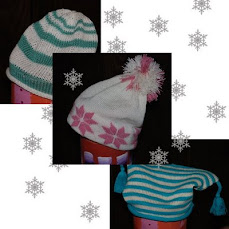
As I posted a few months back, I said I'd post pictures of my 104 hats.  They were done as a guild challenge, which was to knit 104 hats for the year, approximately 2 per week, for charity.  I finished them plus 9 more a while ago but hadn't photographed them.  Not easy to get decent pictures of so many hats.  They are mostly going to an elementary school near where we have our meetings.  Some will go to a group home.  That must be a lot of yarn used up, but why is my stash still so huge? Ha.  I used the midgauge pattern here on my blog in case you need an easy pattern. Varied the sizes from about age 5 to 16 and some for boys, some for girls.  I tried not to make the same hat more than once, but sort of ditched that idea. I got so fast at it---took me 8 minutes to knit one hat, then another 15 to do the pom pom and seam. Made our cruel winter go a little faster.

So anyway.......... voila'.  Here they are in two pictures:

and...

Sunday, July 21, 2019

It warms the cockles of my heart

I haven't the faintest idea where that expression comes from and it's 90 degrees F here as I write so I don't need any warming.  But needless to say, I'm pleased.

The picture on the left is my grandson about 4 years ago and the picture on the right is his little friend who has a Peppa Pig themed birthday party coming up next weekend.  He passed along the Peppa Pig sweater I made him and it looks like it is in good shape still.
It probably didn't get worn much since California is not especially conducive to warm sweaters (or the other way around).  I still have the DesignaKnit pattern I worked up for the Peppa design if anyone wants it.  Just write to me.  I used an iron on nylon interfacing for the motif on the back side and it worked wonders to keep all the floats hidden and in line. It was knit on my 970 as a large motif so the patterning would be easy.

You know how many times you give yourself a B+ and wish you had done something differently?  Well, this time it was the drop shoulder.  I should have done a fitted sleeve or a raglan.  Those little 3 year old shoulders are just too small.  O well.  Live and learn.

Our knitting guild is participating in a challenge where we knit 2 hats  for charity per week ending up with 104 hats to donate for the year.  There are 9 people participating and many of us have done lots more than 2 per week so I imagine we'll end up with close to 1,000 hats.  They'll go to the charity of each person's choice.  There is a needy elementary school near where we hold our meetings so that's where mine will go.  So far I have 110 hats but haven't photo'ed them yet.  Last winter when it was so blasted cold I just stayed in and knit my little heart out.  It got kind of addictive and felt good to be getting that yarn stash down a little.  I found I could knit about 9 hats from one cone, so the stash is still there.  I mostly used the yellow hat pattern with the doubled brim, free on the right side of the blog in case you are interested. I did pom poms on all just because I like them.  Some members have made ear flap hats, some have made doubled so that there are 4 layers over the ears when the brim is folded up.  I just made sure the area over the ears was at least doubled.  Otherwise, they are useless in our extreme winter climate.

So that's all until next time. I hope to take a picture of those hats one of these days...


Thursday, January 31, 2019

It's for the Birds

As I write this, the wind chill in Minneapolis is -66 degrees F.  Tomorrow is supposed to be lots better, but in the meantime, this old girl is staying inside.

My MK guild has a challenge this year to knit 2 charity hats per week from November to November.  That's all I have been doing---and now I have 53 done out of the 102 we're supposed to do.  UGH.  This isn't that much fun, but somehow I'm hooked.  I gotta do it!  One nice thing is that I'm using up some of my stashed cones.  I'm doing them all on the midgauge so there's a lot of doubling up yarn with my Silver Needles cone winder.  By the way, LOVE that thing and highly recommend it.

I have lots of yarn ends as a result of all this knitting.  So, I'm thinking about all these little birdies outside and wondering how in the world they survive in this below zero weather.  I have chopped up some of these yarn ends into 1" pieces and will set this paper plate full outside to see if there are any takers.  (This is just the ends from yesterday's knitting.) I am envisioning colorful nests all over the woods.  If no takers, o well, I tried.  Good intentions.
Will let you know if my good intentions have done any good.

Tuesday, June 26, 2018

Lots Accomplished

  Our machine knitting guild had an "in-town knit camp" this past weekend.  There were 11 of us in a nice room usually used by quilters at a quilt shop.  We all like to go home to our own beds, hence the "in-town" aspect.  My personal goal was to use up some yarn.  I did manage to get 13 hats done.  Not as much yarn used up as you might think. Eating the fantastic potlucks took up some time, don't you know.  Lots of laughs too.   I used the LK 150 for all. (Click picture on right side here for pattern .)
  Here's a good tip.  A guild member's technique for hanging the hem made quick work of it.  He pulls out to d position every other needle, knits one row with main yarn, hangs the metal cast on comb that has the wicked teeth, backwards. (no waste yarn or ravel cord.)   Then he brings the alternate needles to work and knits twice the length of the hem.  Then he brings out every other needle again, puts a weighted metal dowel onto (on top of, across) the knitting and brings up the beginning stitches and hangs all stitches in one fell swoop.  When you tip the cast on bar, the stitches slip onto the needles you have pulled out.  Remove cast on comb.  It requires a little practice, but I love how much time it saves.  It is NOT as pretty as a regular hung hem, but I doubt kids are going to check out the inside of the hat.  Another advantage is that the dowel weights the knitting evenly for the duration.  Try it.  You may agree. You can purchase a metal rod at the hardware store for cheap.  It is nearly impossible to do this if a ribber is attached because you can't get to the bottom of the knitting to grab the cast on comb without dumping the stitches prematurely.  Just a warning.
 
I also knit a Gryffindor scarf for my grandson.  He's currently a fan of Harry Potter.  It's 7 inches across doubled and seamed up the back, about 5 1/2 feet long.  Gauge was about 5 st and 6 r to the inch.  I didn't write it down, but I think it was 70 st by 280 rows, each stripe was 20 rows.  T 9.  Usually I'm religious about writing these things down, but I guess I thought I'd never knit another one.  I used less than 2 skeins of sport weight hand knitting yarn, 100 gr each and I bought 4.  O dear, more charity hats with U of M colors.
  I found a free machine embroidery patch that is the Gryffindor shield and did that at home ahead of time, glued it on with a hot glue gun.  Only problem was that the guy who designed it spelled Griffindor wrong.  So I had to use some emb software to change it to a "Y".  Hard to work on someone else's design but I managed ok. Not perfect, but ok.  Since grandson lives in CA, it's just going to be part of his Harry costume, not really utilitarian.  Too hot.  I think he'll like it, though.
  When he was here a few weeks ago I gave him the robe, glasses and the rep tie.  Pretty cute.  So now he should be all set.

Sunday, October 12, 2014

Machine Knit Flower Hat

I knit so many charity hats, I need a little variation on the theme sometimes...  this pattern has been around our knitting guild for a while.  It's easy and cute.  You can make it on any machine, but you would need to borrow the stitches and rows needed from another pattern for the size you want to make .  This one was knit on a Silver Reed LK 150.
Here are the basic directions:
Happy "gardening"!

Monday, September 1, 2014

Shortcuts to Machine Knit Charity Hats


I'm on a roll, trying to get as many charity hats done before the September 23 deadline when we have to turn them in for the Salvation Army. (IT'S SEPTEMBER ALREADY!!!!!!!!!!) I came up with a couple of time savers.  You might benefit by them too if you do a lot of charity knitting.  I don't think they compromise the looks, so they are working out great for me.  Here they are (nothing earth-shaking, just tiny tips):

Pardon the pictures........hat is squished under the lid of the scanner and the yarn is softer than it looks........................................

1.  I made some cast on rags a few years ago and never used them.  Now I am and although they don't save too much time, they save on waste yarn. Just don't forget to use one row of ravel cord or crochet thread before you knit the main yarn or it's curtains for the cast on rag.  You'd have to cut it out.  Add some claw weights.

2.  When you get to the top of the hat and are ready to decrease, with a one-prong tool, put 3 stitches on one needle across the work. Keep the out- of- work needles at the back of the bed so they don't knit and knit two rows.  Then take off with your seaming thread.  Cinch up tight and seam.  It closes up nicely and if it doesn't look perfect, add a little something to the top, like the gender neutral knotted cord.


3.  The gender neutral knotted cord doesn't have to be knit as an I cord.  Just pull 3-4 needles to work, ewrap on, at tension 2 knit abt 100 rows (for the midgauge), hanging on with one hand as you run the carriage with the other,  and bind off.  Sew the two yarn ends into the tube that naturally forms, knot both ends, knot the middle and tack on securely. This is twice as fast as the regular I cord because every row knits.

4.  Make the hat adjustable for size and age by knitting a large cuff that can either be folded up or down.  This adds extra warmth around the ears.  The cuff is stretchy enough to accommodate about a 2 inch increase in head circumference. The length of the hat also helps in adapting to different sized heads.  Slouchy at first, more fitted later.

If you don't want the cuff so thick, knit 15 rows T5,  15 rows T6, hang a hem and knit the rest of the hat at T 7. Compensate by adding a few inches to the main part of the hat.


Here's the pattern I've been using of late:

YARN  Pound of Love Baby Yarn -generously gifted to me by my good friend Sandy--so far 4 hats with enough for 2 or 3 more out of this one skein.

MACHINE: any midgauge, no ribber required

GAUGE: 4.5 st and 7 rows = 1 inch at Tension 7

FINISHED SIZE:  3-6 months 15  inches circumference/8 inches height (12 months 16 inches circumference/8 1/2 inches height, 18 months 17 inches circumference/9 inches height)

Directions

Start with waste yarn or cast on rag with one row of ravel cord over 78 (80, 82) needles.  With main yarn (no cast on, just knit)  Tension 5, knit 30 rows, Tension 6 knit 30 rows.  Hang a hem.  Change to Tension 7 and knit 40 (44, 46)  rows.  Decrease for the top.  Transfer using the 3 prong tool and move three stitches over two needles. Knit 2 rows, take off on long piece of yarn, cinch and seam with a mattress stitch. Remove waste yarn or cast on rag.    Hide yarn ends, add embellishment cord to the top.

These have been taking me about 15 minutes to knit, 15 minutes to assemble.  Try one and see if you like it. 


PS----How to make a cast on rag-- any machine.  At the left side of the bed, ewrap cast on 2 inches worth of stitches.  Hang a claw weight.  Knit 2 rows.   *Decrease one stitch on the left by transferring the left most needle to the second needle, pull a needle out on the right to increase one, knit 2 rows.* Repeat.   Make as long as you like.  If you want one that accommodates the whole bed, you might have to remove the rag from the right side and place it on the left and keep going.  By just pulling out a needle to increase, you get a loop that you can hang when using it.  At the end, bind off.  Steam/ kill the strip so it lies flat and is floppy.

Thursday, August 21, 2014

To Wrap, or not to wrap. That is the question

I have been doing some charity knitting lately, mostly ear flap hats.  When I make them on the standard gauge machine, I don't wrap the edges of the ear flap because it goes more quickly and the holes are small.  They look ok.  But when I tried this on the midgauge machine, I got a totally different look.  It's not objectionable, could be called a design feature, but wrapping the edges gives a smooth look.  Compare these below:

I used my free pattern---- check out the right side of the blog and scroll down.  Thought I'd give another option in case you are using that pattern.

Thursday, May 8, 2014

Machine Knit Pocket Doll


Still fooling around.....................
 
Pocket Doll Directions  Another fun machine knit toy to make.  Nice to accompany a baby gift or give to charity. 

Any machine, any yarn---Tension to match yarn
Directions
Body  Main yarn, cast on so that you have 6 inches in width.  Knit 5 inches.  Change to skin color of choice.  Knit 1 ½ inches.  Bind off.  No need to shape the top of the head.
Arms – Cast on 2 inches worth in width.  Leave a yarn tail.  Knit 2 inches.  Take off with a large-eyed needle and cinch in for the hand end. Seam up the arm and stuff it.  Wrap yarn around to make hand.  
Hat  -  Ewrap cast on with main or contrasting color the number of stitches in the head plus 4 stitches.  Knit  1 ½ inches.  Decrease by half across, rehang on every needle, knit 2 rows.  Continue decreasing until you have about 5- 6 stitches left.  K for 1” more, bind off.  Tie a knot in the top of the hat.  Seam hat.  Seam the head, stuff the head then hand sew hat to head just under the roll.  Neck- hand sew in and out of stitches where head meets body.  Cinch in for neck and knot.  Stuff the body and seam up back and bottom.  Seam around arms as you attach to the body.  Leave arms sticking out or secure to the belly.  Embroider two tiny eyes with dark yarn going sideways over just one stitch each eye..   Hide all yarn ends inside body.  Dip a q-tip in some blush and make cheeks.

Good beginner project ===  fast, easy, learn how to use your gauge, easy to modify.

Monday, April 28, 2014

Machine Knit Lutin

Sometimes I like to just fool around on my knitting machines with no big goal in mind.  I found this little guy on Ravelry and converted it to a machine knit toy.  I thought it was as cute as a bug's ear.  With no embroidery on the face and no stuffing except for the head, he looks vintage to me.  I tweaked the original pattern a little, especially the extremities because I found it really hard to tie the knots with the fabric doubled.  Otherwise all credit goes to Phildar.

I tried taking pictures of him without a flash and consequently, got weird folds and dark shadows.  He's  really a nice clean baby blue.  Honest!

I built the schematic in DesignaKnit and sometimes the program puts the even numbers on the left and the odd numbers on the right----opposite to where you want your carriage to be.  So, I suggest you ignore one side and just do the same on the other side since the sides are a mirror image. I knit him on a standard gauge machine but you could do your math and redo the pattern to fit a midgauge or bulky.  Lutin is knit in 3 pieces.  Two identical bodies and one hat. He measures about 10" tall and 8" wide.  Good for an extra baby gift, charity or yourself (no diaper changing involved.)

I hope you can read my directions----Blogger reduced the size a little.  If you click on the diagram you will get a slightly larger picture.  Then you can right click and save the image to your Paint program (or any other image processing program.)  It should enlarge a little and be easier to read.

Wednesday, March 12, 2014

Lightening Fast Baby Hats for Charity/Hospitals


I went to a club meeting last Saturday at Cindy's Knitting Room in Princeton.  One of the gals showed a baby hat she had knit on her midgauge machine that I thought was soooooooooo nifty, not to mention awfully fast to do.The hospitals have told us they'd like  pink or blue hats that are 11-12 inches wide (circumference) by 6 inches tall.  Using any machine you can get your gauge and do a little math.  If they come out a little big, you can donate them to a different agency.  The  yarn I had on hand is suitable for the standard gauge machine.  (Mary Lou's Symphony.)  So, I allowed a few more stitches for the roll at the bottom and a couple of rows extra for the top.  I got 7 stitches and 10 rows to the inch with the tension dial about 7.  So I knit them 50 stitches by 124 rows, allowing a little extra width and length.  You can fiddle and eventually get the size you are satisfied with.

What is fast is this.  They are knit lengthwise so the number of stitches is the height of the hat and the length is the circumference.  You start each hat and end each with waste yarn.  Leave a long tail of the main yarn at the beginning of each hat that will be used for seaming and cinching the top.   Fold with the purl side facing you and kitchener stitch the edges together.  Then remove waste yarn.  With the same yarn tail, finish the top of the hat.  The top can be done in a couple of ways.  If you do a short running stitch with the purl side facing you, about 2 stitches down and cinch it tight, it ends up looking like a little flower.  If you do an in and out running  stitch on just every other edge stitch with the wrong (knit) side facing you, cinch it tight, it gathers like most hats are done.  If there is a hole, you can sew north and south, east and west, and it covers up the hole nicely. The knitting naturally rolls to the purl side.  I like it for a change.  And with kitchener stitch there is no seam for the baby's tender head to rest on.

Here's a diagram if that helps visualize the construction better:


What made them super fast for me is the diagram on the right.  I started out with 20 rows of waste yarn, knit the hat, then 20 rows of waste yarn, etc. until I had 10 hats in a long snake-like piece of knitting, ending with the waste yarn.  20 rows of waste yarn was sufficient to have enough space to cut them apart.  Not having to cast on repeatedly, saves a lot of time.  I made 18 of them yesterday in a couple of hours and then spent some time finishing them while watching a movie.  I still need to wash and dry them but that won't take long.

Wanted to share in case you are into charity knitting.  I just thought this was cool and cute and am always happy to find something that goes so fast.  Thanks to Pat!


Tuesday, February 25, 2014

Tuck Baby Blanket

I may have mentioned before that my favorite charity to knit for is the Minnesota Visiting Nurses Association.  They help new mothers and they like to bring a little gift along with them when they visit.  An easy project to knit for charity is a tuck baby blanket.  If you have DesignaKnit, make your design about 186 to 190 stitches wide x 450 to 460 rows long.  Put a 1 x 1 border on the bottom, left and right and the top.  Any tuck pattern will work in the middle of the blanket.  You may need to adjust the number of stitches so that you get even repeats across.  This one uses squares, both single and double tuck rows:

With electronic machines, it's a good idea to do a swatch--- not necessarily for size, but to make sure the tucking is working correctly.  Sometimes, depending on your download to your machine, the tuck and plain stitches get mixed up and you need to do the negative of the pattern.  You'll see right away if it's correct.  If not correct, you get a tangled mess. Something to consider:  tuck stitches that are double length stand out more than the single row tuck.

 
If you have a punch card machine, try something like this.
It has a built-in border when repeated across the bed.  Do a dry run without yarn to make sure you have calculated the correct number of stitches to get the side borders.  Adjust your stitches if needed.  This pattern is 12 stitches by 12 rows.  You can use your 1 x `1 punch card that came with your machine to do the bottom and top borders.  Just switch between punch cards for that.  Be sure to read the section on tuck stitch in your manual.

A nice, and easy edging (pictured above) to control the curl is to crochet the following:  Do one row of single crochet around the entire blanket.  Still with the right side of the blanket facing you, on the next row, single crochet in the first stitch.  Chain 4 and single crochet in the same stitch.  Single crochet in each of the next two stitches.  Repeat around and fasten off.  A mindless thing while watching a movie...