machine knitting midgauge standard bulky machknit knit machine-knit patterns

Tuesday, February 25, 2020

Twisted Headband

I don't think I look that great in headbands, but I just had to try this one.  Check out Itmakesyousmile on Ravelry.  She has good directions and some examples.  I used my Brother 970 standard with ribber, but you could design your own==stockinette, tuck, fairisle, slip, etc.  I just didn't want to bother with a seam up the back.
Here's the skinny on the one I made:
(I made the smaller one, but next will make the larger.)
It knits up really fast and a little longer to twist and seam.  But, not too bad.  (That's a scan.  Looks much nicer in person, of course.)  If you have trouble with the twist, there are videos on Youtube.

Saturday, February 1, 2020

Dog Peace

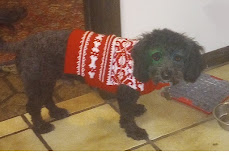
I guess I couldn't bear to throw away my "swatch" (my 200+ row failure from when I knit a scarf for a friend).  I'm usually a thrower, but this was too large to toss.  Had to come up with something, so Ollie is getting another sweater.
View from the top:


I tried to unravel back to a row I could work with but it was too frustrating.  The dark color didn't help any.  So I took it to my sewing machine and sewed two rows across, trying to stay on the same knitted row.  I cut off some extra and almost got it perfect, but this is a dog garment, right???  I just picked up stitches below the sewing machine stitches and knit a fold over neckband.  Then I knit an underpanel.
This is a view from the side.


You can't really see it, but there are holes for his front legs.
The floats in this design are pretty long, so I used some iron-on interfacing.  I wouldn't say I did such a great job cutting it, but it will be hidden on the inside.  It's a dog garment, right???

At least now his claws won't catch on the floats.
I think I'm done making dog clothes for a good long while now.  Especially since spring and warmer temps are right around the corner.

A friend said his doggie friends are going to be jealous of all his new clothes.  Made me chuckle!


Wednesday, January 22, 2020

Peace from Dale of Norway

A few years ago I downloaded this gorgeous pattern, free from Dale of Norway.
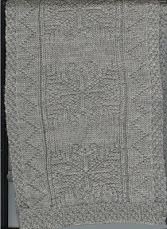
 I haven't yet knit the sweater, but I used the stitch designs to make a warm scarf.  I wore it to a club meeting and one of the gals asked if I would make it for her dad.  He's Norwegian American and proud of his heritage.  So, since I already had the scarf pattern in DAK, it was pretty easy to knit.  I confess I had a mishap about 200 rows in and had to start over.  No problem, really.  I didn't unravel the piece, which I now call my "swatch".  I will try to turn it into a dog sweater for my daughter's little mutt.

Anyway, I am totally in love with this design.  You too can get it here:  https://www.ravelry.com/patterns/library/334-01-peace-jubileumsgenser
You will have to convert it to DAK or I will be willing to email you what I have. (It's a DAK file so you need the program.)

By request, I knit it with acrylic.  Here are some pictures:
This is the back which was originally the design up the sleeves.

This is the front


Because on our knitting machines one can't knit fairisle in the round, the scarf is knit flat then seamed up the back.  Takes some time, but I don't mind watching a movie and hand stitching.  Isn't the pattern yummy?  Took me about 3 hrs to knit (mainly because I had to start over) and 2 hrs to sew up.  Imagine how long it would take to knit by hand!


Friday, January 17, 2020

Sweater Vest for Preemies


I am in search of a project for charity for 2020.  I like to do multiples of the same pattern to make life easy on myself.  Last year it was hats, and I’m over that for a while, even though they were super fast.  This little vest took me an hour to knit and about a half hour to sew all together.  I’m hoping I get faster at it.

Came upon this pattern on the Long Buckby Machine Knitters website a while ago and thought it was such a good idea.  I do want to give credit since this is such an innovative idea.  Seems useful.  The body warmer/vest is for low birth weight babies or those with lines in their arms in the neonatal intensive care unit of the hospital.  Having no sleeves, the vest wouldn’t interfere with the medical intervention.
Of course, like most machine (and maybe hand) knitters, I had to change the pattern a bit. Specifically, I decreased more stitches at the shoulders. Also I didn’t add anything decorative to the body since I wanted this to be speedy.  This is my first draft of the revised pattern, the one I used to knit the vest in the picture.  I am contemplating making the armholes shorter/smaller, but maybe is ok the way it is since the baby would have a sleeper under it.

Machine- standard gauge
Yarn- basically any that works with your machine.  Size isn’t so critical, it will turn out to be a mini size.  Although wool would be warm, acrylic is probably the best choice for easy laundering.  Only takes a few ounces.
Gauge- At tension 7, I got about 7 stitches and 9 rows to the inch on the stockinette, resulting in the vest being about 6 inches wide after the bottom rib and about 6 inches long.  Notice I’m a tad vague here.  J
You will also need 3 small buttons and sewing thread

DIRECTIONS
This is knit in one piece up to the armholes.
RC 000  1 x 1 Rib over 83 stitches, end stitches on the main bed.  After cast on change to T 2/2, knit 10 rows for the rib,  then transfer stitches to the main bed. Attach main carriage. Increase one stitch to 84 stitches.  If you don’t have a ribber, you could do mock rib or a hung hem. Just a word about hung hems on such a small garment, though.  Tried it, even drastically changing the underside of the hem to be tighter---it tends to flip up.  You are certainly welcome to try other hems, though.

Body knit to RC 36.

Armhole and Shoulder  (Be sure to pass the carriage far enough to register the rows. ) Put machine on hold.  Put all stitches in hold except for the 17 stitches on the right end of the machine.  Very furthest stitches on the right end up to be the center of the vest.  Use a full fashioned decrease.  On RC 37 decrease one stitch on left and one stitch on the right.  Knit 2 rows.  RC  39  decrease one stitch on left and one stitch on the right.  Knit 2 rows.  Decrease one stitch on the right only now every 2 rows until you have 10 stitches left.  Knit to RC 64.  Take these stitches off on several rows of waste yarn.

Other armhole and shoulder:  Since your stitches and machine are in hold you can scoot your carriage to the other side of the bed with no dropping of stitches. Repeat what you did on the first shoulder, reversing the shaping.  Take these 10 stitches also off on several rows of waste yarn.

Back Turn the row counter back to 36.  Take the machine off hold.  Knit one row.  Bind off 8 stitches at the beginning of  each of the next 2 rows. Now you have 34 stitches for the back.
Knit plain to RC 64. Put machine on hold, stitches to hold except for the far right 10 stitches.  Take these stitches off on several rows of waste yarn.
Carriage to the other side of the bed.  Put 10 stitches in work and take these stitches off on several rows of waste yarn.
Bind off around the gate pegs these back neck stitches with main yarn.

Join the shoulders  With the right (stockinette ) side facing you, fold back the waste yarn of the shoulder so you can see the purl bumps.  Hang the 10 shoulder stitches, needles all the way out and stitches pushed back.  Fold garment so wrong side is facing you, with the matching shoulder, hang the 10 shoulder stitches in the hooks of the needles.  Close the latches and with a straight edge push the stitches in the hooks through the back stitches.  Use the latch tool to bind off around the gate pegs.  Repeat for the other shoulder.

Button band Do a 1 x 1 rib over 9 needles (5 on main bed and 4 on the ribber).  After the cast on, change to T 2/2 RC 000 and knit 4 rows.  (Super easy buttonhole) *Make a buttonhole by transferring the middle stitch on the main bed to an adjacent stitch on the ribber.  Leave the main bed needle in work.  Knit 12 rows.* Repeat two more times for 3 buttonholes total.  (Row 4, 16, and 28)  Knit to RC 140. Do a loop through loop bind off so the end looks sorta like the beginning.  To do this, transfer the rib stitches to the main bed.  Knit the last row right to left at T 6.  Pull the second stitch through the first across the bed using the larch tool. Fasten off the last loop.

BTW,  I purchased a rib comb that accommodates 60 stitches and it’s ideal for small ribs like this of only 9 stitches. Much lighter weight than the regular ribber comb. Well worth it.  Otherwise you have to use a big clunky ribber comb that came with your ribber, or devise some other method of holding down the stitches.
If you are making this without a ribber you could hang the front stitches all the way around.  Remember to add 3 button holes.

Finishing Sorry there are so many ends to work in.  Will see if I can minimize this.  Remove waste yarn at the shoulders. Find the middle of the rib strip  and the middle of the back neck. Depending on which side you put the buttonholes, you can indicate boy or girl, but this seems unimportant to me.   Pin the mid points together so the band sits evenly.  Mattress stitch the rib to the vest.   Work in the yarn ends.  Sew on 3 small buttons with sewing thread.
I didn’t steam this, but you could. It is recommended to wash without perfume in the detergent or dryer sheets. Put in a sandwich bag to keep clean when donating. 

Thanks to the Long Buckby machine knitters for inspiring me!  Let me know if you give this a try and any modifications you did.


Friday, January 10, 2020

Baby, it's cold outside. Need some footies??


Midgauge Slipper Footies

Knitting Notes and tips:
These are knit on the main bed only, on any midgauge or bulky machine.  Yes, I hid the seam that goes up the side of the instep in the picture, but honestly the seam is not bothersome.   I used two strands of Jaegerspun acrylic yarn which was labeled 3/8.     Use any yarn that achieves the tension indicated in the pattern.  It seems you have to do a bit of experimentation to fit a specific person in which case you'd need to change the stitches and rows. If you are knitting these for charity, they will fit someone.  One strand of navy and one of black made the slipper appear to be knit from variegated yarn.  I strung them through their own eyelets and joined them at the carriage.  To prevent a hole forming on the heel, take the purl bump of the adjacent stitch at the inside of the end of short rowing and exchange it with the adjacent needle. Also try exchanging the stitches to see if you like the look of this better.   
 Because of the rolled hem, it is best to use the stockinette side as the right side.  If you don’t like the rolled hem, you could knit rib either by hand or knit the cuff by latching up the stitches, then proceed with the pattern. Or, if you have a machine with a ribber, have at it.  Since these work up so fast, they’d be a good project for Operation Toasty Toes or other charity that takes slippers.   If you are knitting these with cotton, it’s really important to swatch and wash since cotton is notorious for shrinking.  Call me weird, but I like to knit a big rectangle, wash it and put it in the dryer, then rewind the yarn.  That way it is preshrunk and the gauge is pretty much accurate.

Machine:  Any midgauge; bulky would work achieving the same gauge
Yarn: Any yarn to achieve the same tension if you want to follow the pattern. I used yarn that was slightly thinner than sport and doubled it.  Do a swatch with your chosen yarn to get the same gauge.
Tension:  at T 5, 4 st x 7 rows = 1” with yarn doubled
Finished size of large = man’s shoe size 10-11 
 Sizes medium and (large).  If one number, it applies to both sizes.  You’ll have to experiment if the first try doesn’t fit.
Directions:
With waste yarn, cast on over 46 (48) N, knit a few rows, one row ravel cord.  With main yarn ewrap on, leaving a 12” tail for seaming.  Knit at T 3 for 12 R for roll hem.  Change to T 5 Knit 8 rows (7 rows for second footie to end on left side of bed).  Note:  if you want these to rise higher on the ankle, knit more rows here.
Heel – Set carriage to hold position.  Pull all needles left of zero to hold.  Short row down to 8 working needles by pulling the working N closest to the carriage to hold before each row. Reverse short row by putting the needle opposite the carriage into working position, knit the row, until all N are in work again.  Remember to close up the hole before you begin doing the reverse short rowing.
Put carriage on N. All needles knit.
Foot-  RC 000.  Knit 42 (48) rows. (Use an odd number to end up at the left side for the second footie’s heel.)
Toe – Knit exactly as you did the heel.   (Another option is to do ff decreases for the toe.  Some people like the look of this better.)
Knit one row overall with main yarn and then remove on several rows of waste yarn.  
Fold the waste yarn back and kitchener stitch the toe seam.  I find it is easier to graft from the purl side.  Remove waste yarn.  Do a flat seam for the side. Hide yarn tails.  Knit the second footie putting the heel and toe on the other side of the bed. 


Using the same basic design, you can make women’s footies.  You’ll need to experiment to find out how many stitches and rows to do.  My stitches and rows for a size 6 shoe with  Bernat Baby Boucle was 6 st and 8 rows to 1”  I cast on 42 stitches, did 10 rows for the hem and did 38 rows for the foot.   I’m not even sure this yarn is made anymore so you will really have to calculate your own with your chosen yarn! 
The fluffiness of the boucle made it ideal to use the purl side as the right side.  When you do this it totally hides seams so that the slipper looks like it is knit in the round.  The only difference from the above pattern is that, rather than making a rolled hem, this hem is hung from the first row.  You would begin with waste yarn, knit a few rows, then change to main yarn and knit the number of rows you want for the depth of the hem x 2.  (Don’t do a permanent cast on with the main yarn, just knit.) To make the hem, pick up the first row and hang it on top of the stitches in work.  It naturally rolls to the outside.  On the picture you can see that the hem is stockinette on the outside but the body of the footie is purl stitches.
Be sure to write down your gauge, number of stitches to use, number of rows for the hem, rows for the foot and anything else.  I have been known to knit merrily away and forgot to write down the vital info so had to take a wild guess for slipper #2.  Sometimes successfully!  Sometimes not.
      

Wednesday, December 18, 2019

Fuzzy Feet Revisited

Wanted to make a specific size with different wool than I had used in the past on my LK 150 midgauge.  This exercise just reinforced the fact that felting/fulling is really unpredictable.  These are intended for my 8 year old grandson as a stocking stuffer.  Guessing the stitches and rows,  I did 50 stitches x 60 rows, every other needle. (I am counting the actual stitches, not total needles on the machine.)  On my bulky machine I could use every needle.  No go on the midgauge.  Since the midgauge didn't especially like this yarn or the fact that there were two strands (one wool and one fun fur) I kept the fun fur on the floor and hand fed it with the yarn in the mast, both going into the carriage together.  So far so good.  These take very little time to knit.  After aggressive felting in the washing machine, they turned out to be my size. Pretty large.

Back to the drawing board.  This time I used 25 stitches and 40 rows.  Wild guess.  8 rows each color: red, yellow, purple, green, royal blue.  Same method.  Yea! they turned out the right size for an 8 year old, about 9" long.  I bought some googly eyes and sewed them on, also adding a dot of permanent fabric glue to hold the eyes in place.  Don't know if the eyes themselves will withstand washing, but won't be a tragedy if they don't.  Non- threatening monster slippers!  The slippers are really soft and so cute!

Posting this so that you know--- if you make them--- the process might take a few tries.  Unfortunately once they are felted, you can't undo them.  But if they turn out a size you didn't intend, they should fit someone! Check out my previous post for more specific directions.

Sunday, December 15, 2019

Another Stocking Stuffer : Quick Cowl


Cablely Cowl    by Mar Heck  ©2019

This is a really easy cowl/neck warmer that you can knit up in really short order.  Makes a nice gift and you can make several for yourself too!  I knit it on a midgauge machine, but you could make it on other machines adjusting the gauge so that you end up with a cowl that is 6”+ x 24”+. Use any yarn that works with your machine.  Variegated is nice.  The cables make automatic buttonholes!   Directions are given for the midgauge or bulky.  To knit on other gauge machines, get your gauge, then take a tape measure or piece of yarn and wind around your neck to see what length you want.

Machine:  Midgauge – I used Brother KX 350
Yarn:  Lion Brand Wool, worsted weight, run together with mill end variegated thread (poly and cotton slubs) – optional, or use any worsted weight yarn.
Other:  2 one inch buttons
Gauge:  4 st x 5 rows = 1”  (not too critical because you can block and also adjust the button placement)
Suggested Finished sizes:  After blocking, 6” height x 22” length, 8” x 24”,  8” x 28”

Directions:  Cast on with waste yarn over needles R 1-25 and knit a few rows T 10. 5
 E wrap loosely over all needles with main yarn. Knit one row.  Transfer stitches as in diagram.


In other words, put needles 3, 8, 13, 18, 23 out of work when you cast on over right 1-25.  If you are making a wider scarf, continue in the same pattern leaving two plain stitches at the sides.

Knit 10 rows.  (I did 10 rows because it is faster and also easier to keep track of on the row counter.)  Cable:  With two 2-prong tools, *make a 2 x 2 cable on stitches 4,5,6,7—9,10,11,12—14,15,16,17—19,20,21,22 (counting the needles out of work),   Knit 10 rows.* Repeat from * to * 8 or more times, knit 10 rows plain, one loose row and chain cast off pulling next stitch through the previous stitch with your latch hook.  OR, use the bind off of your choice.  Remove waste yarn.   Note that the sides of the cables form holes that are decorative and also act as automatic buttonholes. And, with serious blocking, you can make scallops.


Finishing:  Block the rectangle aggressively, pinning out the space between cables on both edges to make curvy lines.  Steam press hard if using wool, steam above the fabric if using acrylic, and leave pinned until it dries.  Remove waste yarn and sew in/hide yarn ends.  Sew on buttons two inches in from the end. (Or, adjust size for recipient.)  OPTIONAL- Bend over top corner and tack down invisibly with sewing thread.  I left the bottom more open rather than sewing on another button to better conform to a person’s neck, but you can add a 3rd button.  The red cowl pictured is more fitted to the neck.  You may want a looser one.