machine knitting midgauge standard bulky machknit knit machine-knit patterns

Friday, January 10, 2020

Baby, it's cold outside. Need some footies??


Midgauge Slipper Footies

Knitting Notes and tips:
These are knit on the main bed only, on any midgauge or bulky machine.  Yes, I hid the seam that goes up the side of the instep in the picture, but honestly the seam is not bothersome.   I used two strands of Jaegerspun acrylic yarn which was labeled 3/8.     Use any yarn that achieves the tension indicated in the pattern.  It seems you have to do a bit of experimentation to fit a specific person in which case you'd need to change the stitches and rows. If you are knitting these for charity, they will fit someone.  One strand of navy and one of black made the slipper appear to be knit from variegated yarn.  I strung them through their own eyelets and joined them at the carriage.  To prevent a hole forming on the heel, take the purl bump of the adjacent stitch at the inside of the end of short rowing and exchange it with the adjacent needle. Also try exchanging the stitches to see if you like the look of this better.   
 Because of the rolled hem, it is best to use the stockinette side as the right side.  If you don’t like the rolled hem, you could knit rib either by hand or knit the cuff by latching up the stitches, then proceed with the pattern. Or, if you have a machine with a ribber, have at it.  Since these work up so fast, they’d be a good project for Operation Toasty Toes or other charity that takes slippers.   If you are knitting these with cotton, it’s really important to swatch and wash since cotton is notorious for shrinking.  Call me weird, but I like to knit a big rectangle, wash it and put it in the dryer, then rewind the yarn.  That way it is preshrunk and the gauge is pretty much accurate.

Machine:  Any midgauge; bulky would work achieving the same gauge
Yarn: Any yarn to achieve the same tension if you want to follow the pattern. I used yarn that was slightly thinner than sport and doubled it.  Do a swatch with your chosen yarn to get the same gauge.
Tension:  at T 5, 4 st x 7 rows = 1” with yarn doubled
Finished size of large = man’s shoe size 10-11 
 Sizes medium and (large).  If one number, it applies to both sizes.  You’ll have to experiment if the first try doesn’t fit.
Directions:
With waste yarn, cast on over 46 (48) N, knit a few rows, one row ravel cord.  With main yarn ewrap on, leaving a 12” tail for seaming.  Knit at T 3 for 12 R for roll hem.  Change to T 5 Knit 8 rows (7 rows for second footie to end on left side of bed).  Note:  if you want these to rise higher on the ankle, knit more rows here.
Heel – Set carriage to hold position.  Pull all needles left of zero to hold.  Short row down to 8 working needles by pulling the working N closest to the carriage to hold before each row. Reverse short row by putting the needle opposite the carriage into working position, knit the row, until all N are in work again.  Remember to close up the hole before you begin doing the reverse short rowing.
Put carriage on N. All needles knit.
Foot-  RC 000.  Knit 42 (48) rows. (Use an odd number to end up at the left side for the second footie’s heel.)
Toe – Knit exactly as you did the heel.   (Another option is to do ff decreases for the toe.  Some people like the look of this better.)
Knit one row overall with main yarn and then remove on several rows of waste yarn.  
Fold the waste yarn back and kitchener stitch the toe seam.  I find it is easier to graft from the purl side.  Remove waste yarn.  Do a flat seam for the side. Hide yarn tails.  Knit the second footie putting the heel and toe on the other side of the bed. 


Using the same basic design, you can make women’s footies.  You’ll need to experiment to find out how many stitches and rows to do.  My stitches and rows for a size 6 shoe with  Bernat Baby Boucle was 6 st and 8 rows to 1”  I cast on 42 stitches, did 10 rows for the hem and did 38 rows for the foot.   I’m not even sure this yarn is made anymore so you will really have to calculate your own with your chosen yarn! 
The fluffiness of the boucle made it ideal to use the purl side as the right side.  When you do this it totally hides seams so that the slipper looks like it is knit in the round.  The only difference from the above pattern is that, rather than making a rolled hem, this hem is hung from the first row.  You would begin with waste yarn, knit a few rows, then change to main yarn and knit the number of rows you want for the depth of the hem x 2.  (Don’t do a permanent cast on with the main yarn, just knit.) To make the hem, pick up the first row and hang it on top of the stitches in work.  It naturally rolls to the outside.  On the picture you can see that the hem is stockinette on the outside but the body of the footie is purl stitches.
Be sure to write down your gauge, number of stitches to use, number of rows for the hem, rows for the foot and anything else.  I have been known to knit merrily away and forgot to write down the vital info so had to take a wild guess for slipper #2.  Sometimes successfully!  Sometimes not.
      

Wednesday, December 18, 2019

Fuzzy Feet Revisited

Wanted to make a specific size with different wool than I had used in the past on my LK 150 midgauge.  This exercise just reinforced the fact that felting/fulling is really unpredictable.  These are intended for my 8 year old grandson as a stocking stuffer.  Guessing the stitches and rows,  I did 50 stitches x 60 rows, every other needle. (I am counting the actual stitches, not total needles on the machine.)  On my bulky machine I could use every needle.  No go on the midgauge.  Since the midgauge didn't especially like this yarn or the fact that there were two strands (one wool and one fun fur) I kept the fun fur on the floor and hand fed it with the yarn in the mast, both going into the carriage together.  So far so good.  These take very little time to knit.  After aggressive felting in the washing machine, they turned out to be my size. Pretty large.

Back to the drawing board.  This time I used 25 stitches and 40 rows.  Wild guess.  8 rows each color: red, yellow, purple, green, royal blue.  Same method.  Yea! they turned out the right size for an 8 year old, about 9" long.  I bought some googly eyes and sewed them on, also adding a dot of permanent fabric glue to hold the eyes in place.  Don't know if the eyes themselves will withstand washing, but won't be a tragedy if they don't.  Non- threatening monster slippers!  The slippers are really soft and so cute!

Posting this so that you know--- if you make them--- the process might take a few tries.  Unfortunately once they are felted, you can't undo them.  But if they turn out a size you didn't intend, they should fit someone! Check out my previous post for more specific directions.

Sunday, December 15, 2019

Another Stocking Stuffer : Quick Cowl


Cablely Cowl    by Mar Heck  ©2019

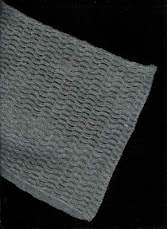
This is a really easy cowl/neck warmer that you can knit up in really short order.  Makes a nice gift and you can make several for yourself too!  I knit it on a midgauge machine, but you could make it on other machines adjusting the gauge so that you end up with a cowl that is 6”+ x 24”+. Use any yarn that works with your machine.  Variegated is nice.  The cables make automatic buttonholes!   Directions are given for the midgauge or bulky.  To knit on other gauge machines, get your gauge, then take a tape measure or piece of yarn and wind around your neck to see what length you want.

Machine:  Midgauge – I used Brother KX 350
Yarn:  Lion Brand Wool, worsted weight, run together with mill end variegated thread (poly and cotton slubs) – optional, or use any worsted weight yarn.
Other:  2 one inch buttons
Gauge:  4 st x 5 rows = 1”  (not too critical because you can block and also adjust the button placement)
Suggested Finished sizes:  After blocking, 6” height x 22” length, 8” x 24”,  8” x 28”

Directions:  Cast on with waste yarn over needles R 1-25 and knit a few rows T 10. 5
 E wrap loosely over all needles with main yarn. Knit one row.  Transfer stitches as in diagram.


In other words, put needles 3, 8, 13, 18, 23 out of work when you cast on over right 1-25.  If you are making a wider scarf, continue in the same pattern leaving two plain stitches at the sides.

Knit 10 rows.  (I did 10 rows because it is faster and also easier to keep track of on the row counter.)  Cable:  With two 2-prong tools, *make a 2 x 2 cable on stitches 4,5,6,7—9,10,11,12—14,15,16,17—19,20,21,22 (counting the needles out of work),   Knit 10 rows.* Repeat from * to * 8 or more times, knit 10 rows plain, one loose row and chain cast off pulling next stitch through the previous stitch with your latch hook.  OR, use the bind off of your choice.  Remove waste yarn.   Note that the sides of the cables form holes that are decorative and also act as automatic buttonholes. And, with serious blocking, you can make scallops.


Finishing:  Block the rectangle aggressively, pinning out the space between cables on both edges to make curvy lines.  Steam press hard if using wool, steam above the fabric if using acrylic, and leave pinned until it dries.  Remove waste yarn and sew in/hide yarn ends.  Sew on buttons two inches in from the end. (Or, adjust size for recipient.)  OPTIONAL- Bend over top corner and tack down invisibly with sewing thread.  I left the bottom more open rather than sewing on another button to better conform to a person’s neck, but you can add a 3rd button.  The red cowl pictured is more fitted to the neck.  You may want a looser one.

Saturday, November 30, 2019

Need a stocking stuffer? Knit some Fuzzy Feet Slippers


Fuzzy Feet  by Mar Heck ©2019

 This pattern is adapted from an easy, old, hand- knit slipper pattern that for years has been passed along from grandmother to grandchild and probably has been knit a million times.   Adding three twists to the pattern:  they are done on the machine in lightening quick fashion in stockinette stitch, we are adding fun fur to tickle our fancy and we are felting them to make them extra warm. MACHINE:   9 mm Bulky or midgauge 

SIZES:
   Child to adult.  Adult in parenthesis.

MATERIALS NEEDED:
  3 (4) skeins Lion Brand Fun Fur™ (60 yards per skein, polyester), purple used for the sample
  1 (2) skeins knitting worsted weight wool yarn (Do not use wool yarn made to resist
   felting,  called superwash.) Light blue used for the sample.   Large eyed needle for sewing up

SKILL LEVEL:
    Beginner.
         Skills needed:  Making a swatch and determining gauge
                                E wrap cast on.               
                                Mattress stitch for hand sewing.


DIRECTIONS:

1.  Determine the recipient’s foot size by taking two measurements.  Measure the foot length from heel to toe and then measure around the instep close to the ankle.  The foot length will be the finished slipper length (number of rows)  and the width will be how high the slipper comes up each side of the foot on the sides of the heel/ankle (number of stitches).  The slipper is just a plain rectangle.

2.  Make a swatch .  You will make the slipper the size of the felted gauge. With one strand of fun fur and one strand of the wool held together, e wrap cast on 20 stitches and knit 30 rows at the largest tension your machine will do.  End with waste yarn and remove from machine.  The waste yarn will tell you which direction is the rows.  If it felts really well, it’s hard to otherwise tell which direction is which.  It will feel like a big waste of yarn, but you’ll only have to do this once for a particular brand of wool.  (You might be able to later think of a use for this little swatch.)  Throw the swatch in the washing machine until the wool felts.  Depending on the yarn you choose it may take a few cycles for it to felt.  After it attains the look you want, measure the swatch to determine stitches and rows per inch or centimeters, whichever you are more comfortable with.   Multiply the stitches and rows per inch times the dimensions you want to determine how many stitches and rows you will knit for your rectangle.  (See note below for calculating.) Note that it will have shrunk more in length than in width.

***If you prefer not to make a swatch, for a rough reference:  using the largest tension, my child’s slipper turned out to be at T 10.. 44 stitches X 50 rows to fit an 7-8” foot.  My adult women’s slipper, about a size 9, turned out to be 50 stitches X 74 rows to fit a 9 -10 inch foot. Because felting is not an exact science, you’ll need to do a little experimenting with the yarn you choose.  If you use the same yarns for different sizes, you can knit a pair using your best guesses for stitches and rows then adjust for other sizes by adding or subtracting stitches and rows. This works fine if you would prefer not to waste yarn on a swatch.  (You can’t reuse yarn that’s been felted, so some people would prefer to just dive right in.)    Another thought: you will want the slipper to be a bit snug, so do not add any ease.

3.  Directions for knitting.  Knit one rectangle for each  slipper.

*  E wrap cast on loosely from left to right with one strand of each yarn held together over the number of needles  you have determined you need.  Leave a yarn tail at the beginning about 10” long to later sew up the heel seam.

*  Put the yarns together in the feeder and turn the dial to the largest tension number.  Set your row counter to zero and knit one row from right to left.  (May be a bit hard to push the carriage.)

*  Hook the cast on comb into the stitches.  Add as much weight across the knitting as you can. Use ribber weights if you have them.  For the first 2-3 rows, pull all needles out to E position each row to make the stitches knit off a little easier.  Yank the knitting down after each row so that the fur doesn’t get hung up on the gate pegs.  Knit the number of rows you have determined you need.

*  End with the carriage on the right side.  Take the yarn out of the feeder and cut a length of the two yarns about 1 ½ feet long which will be used for sewing up the top of the slipper. ( I sewed mine first then felted them. ) Thread both strands into a large eyed  needle and take the stitches off their needles, one at a time from right to left onto this thread.  When all stitches are off the machine, pull the stitches as tight as you can.  This will be the toe.  You will most likely have a little hole, so stitch across the hole from north to south and east to west a few times.  Neatness doesn’t count because the felting and the fur will hide your sewing.

* Don’t break yarn.  With this same length of yarn, sew up the top of the foot seam with a mattress stitch from the toe towards the back of the slipper.  Again, for reference, I sewed a 3 inch seam for the child’s slipper and a 4 inch seam for the adult.  Fasten off by sewing through your last stitch again and then hide the yarn tail inside the slipper by sewing through the backs of 5-6 stitches and cutting the yarn off.   You need a large enough opening to slip the foot into, but small enough to stay on snugly.

*   Thread both strands of your beginning yarn tail into a large eyed needle and sew up the heel seam. You will be folding the back of the slipper in half and sewing from top to bottom.  The stitches face each other, so you can’t do a mattress stitch.  Any seam will do. Sew twice for strength.  Hide the yarn tail as above.

*  Note:  the edge that ends up around the ankle needs no treatment.  When felted it lies perfectly flat.  No problem there!

4.  Felt both slippers at the same time in the same wash load(s) giving them the same treatment as you did your swatch.  My wool needed 3 hot/cold cycles to felt, but each yarn brand seems to behave differently as do different colors, so you just need to monitor it.  When felted to the size you need, scrunch up some plastic bags, stuff the slippers so they have a nice shape and let them dry for a day or so.  Petting them doesn’t prolong the drying period, so have at it.  It’s amazing how the wool pulls together and makes the non-felting polyester “fur” more dense.  People are kind of surprised you can do this on a machine.  Just one bit of warning, they’re slippery on smooth floors.

5.  I found this addictive and made several pairs. They are so soft and cozy! For your next pair, you can do stripes and/or embellish them with bows, eyes, ears, tails, whatever.  Baby booties would be really cute and easy.  Because of the slippery nature of the slippers  (is that how the word came about?), the pattern may not be appropriate for toddlers or older folk.  You decide.  Once you have your gauge, the next pair is a snap. They are so silly, they’re fun!

New Knitter Notes:

Ewrap Cast On:
Pull needles that are going to be in work out to E position.  Make a slip knot and hang it on first needle on the left.  Push the knot back to the needle bed.  Just as though you were writing a cursive “e”, wrap the yarn around each needle counter clockwise, from left to right up against the bed, not in the hooks of the needles.  Easy does it---don’t wrap too tightly.  No need to wrap the last needle on the right.  Just put the yarn in the yarn feeder and that stitch will knit automatically as you push the carriage from right to left.  After your first row, hang the cast-on comb.

One way to calculate the stitches and rows per inch:
This simple method works in this case since we are dealing in approximations anyway.  For a sweater, you would want to do a more extensive swatch.  In this example, you knit 20 stitches and 30 rows and then felt your swatch.  When it has felted to your liking, measure the width.  Say your swatch, after felting, measures 4 inches across.  20 stitches divided by 4 inches = 5 stitches per inch.  To get your number of stitches for the width of the slipper, multiply 5 times the number of inches you want.  Say the length ended up to be 5 inches.  30 rows divided by 5 inches = 6 rows per inch.  To get the number of rows for the length of the slipper, multiply 6 times the number of inches you want.

Hand sewing a mattress stitch: 
Have the right sides of both pieces facing you, side by side.  With your large needle, go under two bars on the right side of the first stitch of the piece on the right, then under two bars on the left side of the first stitch on the left piece.  Go back and forth repeating from side to side, pulling the yarn taut now and then.  The stitches from each side pull together making the seam invisible from the right side.


Tuesday, November 26, 2019

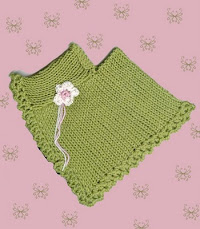
Christine Linfeld’s shawl as a poncho


ridelikethewind’s PONCHO
Check out her poncho on Ravelry in her projects.  Hers is much prettier than mine, I'm afraid.  She used worsted weight yarn on a midgauge so her gauge is larger than mine, that is less stitches and rows. She was inspired by Bill King's waterfall sweater. She kindly helped me get my head around the construction and once I caught on, it was easy and went fast,

I used mohair from Cindy Schmatz when she had a yarn sale.  I used about 10- 50 gr hand knitting skeins I think…   Wound onto cones.  Unfortunately, I lost track!  Used my  LK 150 at T 4.


There are eyelets down center front and center back only, not also over the shoulders as in the original Christine Linfeld’s shawl. Also, the original shawl has 4 points.  This has two: one in front and one in back.

Overview of construction:


Start with waste yarn several rows and 1 row ravel cord over (110) needles.  On last row of waste yarn, transfer to the needle setup of lllxlllx….  Add extra stitches at each side which will be neck and bottom edges.
 Start with straight section and knit (72) rows. CAR.

Begin short rows: Set machine to hold. At the opposite side of the carriage, Hold 3 needles, knit 4 rows.  At the same time, short row at the neck (left side) 3 additional stitches and wrap end n every 8 rows.  (didn’t do enough the first time see note at end)
Finish short rowing:  Opposite the carriage put 3 N in work, knit 4 rows until all N are in work.

Straight section: Knit the same number of rows as you did the first time.  Front (or back) completed.


Repeat the whole thing for the other side of the poncho.


End with one row of ravel cord and  then several rows of waste yarn. You will be joining at one shoulder.  Kitchener stitch the seam.  It’s kind of awkward kitchener stitching because of the needle out of work loop.  Try to stitch 3 st to three st so it looks continuous but lies flat.  Truly it takes much longer to seam this than it did to knit it,  Run in any yarn tails.


Additional comments:  I recommend using a highly contrasting waste yarn color to help you find the stitches for kitchenering.  I have put my measurements in parenthesis because you will want to use your own number of stitches, hence rows.  I am rather fluffy these days so mine is XL, which is comfy for a poncho for me.  Because I didn't short row the neck enough, the neck turned out huge!  She ended up with 22 ridges, I have 27.
 Attempt to tighten neck because I didn't want to rip out the whole thing!!!:
3.25 crochet hook, yarn DOUBLED.  Chain stitch (not sc) around starting at shoulder picking up every other knit stitch x 9 then skip 2 knit st for the 10th  chainstitch. Row 2 chain in each chain st.


Mine ended up with these measurements:


32" seems like a lot for the neck, but it really isn't.  I prefer to not have clothing tight around the neck.  This sits nicely on the shoulders.  The neck doesn’t look so puffy when worn so I’m not that unhappy about it.  Next time:  short row  # ????  Will need to experiment.  Did leave the bottom edge alone even though it curls a little.


Close up of eyelets:


 Red is super hard to photograph, especially with this cheap phone camera of mine. Plus the halo of the mohair doesn't show. As always looks much nicer in person.  I hope you have a good imagination because this pattern really is a gem.  I think it will be good to wear this in spring and fall and also in the house when temps are below zero outside. 


Tuesday, November 12, 2019

Garter Carriage Running Again

I bought my garter carriage years and years ago.  Used it to make a few things, put it on the shelf and forgot about it.   Kind of dumb to let a piece of equipment go unused, right?  Judging from members of my mk guild, it's common to NOT use it.  People are a little intimidated.  So, not having used it for a good while,  I took a refresher class from Cindy Schmatz sponsored by our mk guild and got the thing going again.  It's an 89 version with a new motor.  She tells me it's exactly like the newer versions but will not cast on automatically like the newer models do.  I can e-wrap just fine.  So I'm happy about that.

After a couple of mishaps (the main one not getting the carriage seated properly on the bed and it made a terrible clanking sound) I had some success.  The first thing I made was a baby hat.  Not so many stitches and rows, so it went faster than some other projects I hoped to make.  I shoulda/coulda wiped out the partial stars on the seam edges, but just wanted to see if it would chug along correctly.  No dropped stitches, feeling pretty good about things.  This baby hat wouldn't be warm enough in a Minnesota winter, but under the hood of a snowsuit would be ok. 
The rib looks ok (better than the picture shows) but I coulda/shoulda done that part with the ribber in 1/10 the time.  (Next time.)  The pattern is large snowflakes from a Brother G carriage book.

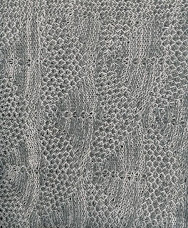
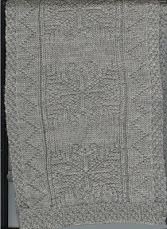
So- gaining some confidence, I programmed in another Brother G carriage pattern (073) adding 2 x 2 staggered edgings so it wouldn't roll.  I love this design.  My friend Sandy I. has made gorgeous baby blankets with it.  I made it long--- the length is the width worn--- and have worn it doubled since it wouldn't be super warm with a single layer using this particular yarn.  Since this cowl is 127 stitches and 372 rows it took maybe 16 hours to knit! I kitchenered the first row to the last but that's all I had to do other than hiding 2 yarn tails.   Here's a screen shot of the DAK pattern:

And a picture of the cowl folded double:

I have read that one shouldn't steam garter carriage stuff, so I didn't.  The picture doesn't show the texture as nice as it is in person,  Nice! I like it.

I have some  wool that would be warm enough with a single layer, so I changed the middle pattern to half.  Same Brother pattern.  Haven't knit it yet, but it's on my to-do list.  This is a screen shot of that pattern:

Being 68 stitches it will go a little faster.

Here's the original 24 st punch card pattern from Brother that I manipulated in DAK.

 If you have DAK and would like any of these patterns emailed to you, write to me and I'll send. 

It's getting cold here already so the extra winter wear is welcome.

Friday, November 8, 2019

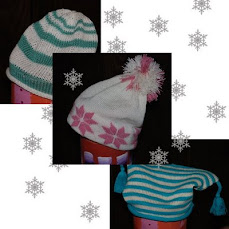
How to knit mk hats---- lightening fast


I posted this on Ravelry in the machine knitting group, but some people may not belong.  So I thought I'd repeat my post here hoping it will help someone. I should give credit to my friend, Bruce, who taught me this trick.
Some people have asked how I can make hats “in minutes” on my knitting machine. Here’s how.
  1. For my charity hats, I used a midgauge which requires less stitches and rows than a standard. Sometimes I had to double the yarn. A bulky would even be faster.
  1. The trick: Buy a metal rod that is the length of the width of your knitting machine. (Very cheap at hardware store.) Should be substantial in weight.
-Pull out every other needle for the width of the hat and knit one row main yarn. (no waste yarn)
- Hang your cast on comb BACKWARDS making sure each loop gets a tooth of the cast on comb.
-Pull out the rest of the needles so they will knit.
-Knit 2 times the length of the hem.
-Bring out every other needle all the way.
- Hang onto the cast on comb with your left hand pulling down slightly
-place the metal rod mid way, horizontally.
-Pull up the cast on comb up over the rod, hang loops so that each needle that is all the way out gets a loop. Takes some practice at first. Remove cast comb by tilting it so that the stitches land properly. If you miss some, use a single transfer tool to hang them.
-The rod is still in the hem and acts as an even weight throughout. Set the cast on comb aside.
-Knit the height of the hat and transfer every other stitch to its neighbor. Push out of work needles to out of work position so they do not knit but you don’t have to move the stitches inward.
-knit one row and take stitches off (I try to plan so the last row goes left to right because I am right handed) with a double eyed needle and enough of a yarn tail to sew the seam. Remove metal rod. It will start to fall down anyway. The stitches at the top cinch in just fine, especially if you are going to attach a pom pom which hides the opening. Seam the side.
The inside of the hem is not especially beautiful, but show me a kid who cares.
7 minutes knitting time! (Works with any machine) Sorry I don’t have pictures or a video. Hopefully my words are clear enough. Write to me if questions.  PS  I used the free pattern on my blog here and pictured below.