machine knitting midgauge standard bulky machknit knit machine-knit patterns

Saturday, May 7, 2011

Every moral has a story...


What a crazy last two days!!! Long story coming....no, you can't buy DAK at a computer store, sadly.

My son's car needed an oil change. The car dealership said they'd have his car for several hours. So, he called and asked if I'd pick him up at a nearby computer store that he could walk to. If I could pick him up, he could be at home while the car was being worked on. Since I'm such a good mom, I said sure. Keep in mind, this store is about 11 miles from my house.

Trip 1, going to pick up the son from the computer store. The drama begins. I can't resist looking at stuff in a computer store and noticed they had some refurbished laptops with WINDOWS XP on them!!!! Since DAK works great with XP, I don't own a laptop and kind of think I need one, Windows XP is a rare dinosaur, it was a reasonable price, I thought this would be good insurance/backup for when I no longer have a computer that works with DAK. So went my fairly reasonable thought process. As a result, I happily took an IBM Thinkpad home with me. Took me a couple of hours to get connected to the internet, download and install Norton anti-virus, download updates for the anti-virus, upgrade the XP stuff from Microsoft, stuck in DAK to see if it liked its new home, etc. etc. etc. I was minding my own business, surfing, etc. and suddenly the blue screen of death came up and said "Hardware failure. Return computer to administrator/seller" or something like that. These laptops were used by businesses and then (supposedly) refurbished. So, even though I couldn't turn the d*** thing off, I could get the disk out. I put everything back together and returned the laptop to the store and got an exchange. Trip 2. No problem.

Did all the preparation as described above with the Thinkpad laptop replacement. Something niggled at me and I finally realized there was no sound on this computer. Went to every place on the computer that deals with sound and increased the volume to the max. Went to the website and downloaded a new driver. Nothing worked. Getting disgusted now! Too many hours invested. So I uninstalled DAK, packed everything up and returned to the store for a REFUND. Trip 3. Done with this nonsense!

They were really nice about it at the store and I was feeling pretty good about my decision to quit messing around with a refurbished computer. I'll take my chances with the two computers I have at home that work fine with DAK.

When I got home, I thought I would convert a Dale of Norway baby graph to a stitch pattern and start working on a sweater for the little guy. YIKES!!! no DAK disk. (I always run DAK from the disk.) Absolute panic when I realized I returned the disk to the store, still in the laptop's cd drive. I called the store and the employee (John the phone guy) sounded a bit irritated but said he'd look for the computer and see if the disk was still there, then call me back. This is a big computer store, a national chain, and I thought there was a possibility that the computer was already on a truck ready to be transported somewhere. Had already rationalized in my head the purchase of a replacement DAK disk. I was almost in tears when...........brinnnnnnnnng! The phone rang, he had it, I could come pick it up. Geeze Louise!!! I think if I hadn't wanted to work on DAK right away, the computer and disk would have been gone. Thanked my lucky stars. 4 round trips in two days. Don't even care about the wasted, expensive gas anymore.

Moral of the story: USE YOUR DAK EVERY DAY!

PS Car got its oil change. On one of those trips, the son got transported to his car. I was so focused on the DAK and the stubborn laptop, I can't even remember where in the sequence I took him to the car place. After all, first things first.

Friday, April 8, 2011

What has your knitting machine come up with now?


This is probably a trick you learned long ago. If so, disregard this post. Maybe some readers haven't tried this time-saving technique, though, so I'll soldier on. To make a short story long, I had my kitchen redone. Looking at my old dishcloths, I decided they had to go. Needed some new ones to match the fresh new look of the kitchen. So, I had a nice cone of turquoise cotton that would do the trick. Rather than knit each one separately, I did the waste yarn method of knitting a continuous strip. You'll need a fairly fine crochet hook. If you don't have one, you may be able to get by with your latch hook, but I find it more difficult to use than a plain crochet hook when doing this.

Here's what you do: (Directions apply to a standard gauge Brother machine. You would adapt for other gauges and machines.)

1. Cast on any old way with waste yarn over 61 stitches. Knit about 12 rows to make sure things don't unravel. You're going to need quite a bit of weight to help the tuck stitches knit off. Move them up every few inches.
2. Pull off main yarn that is 4 times the width of the knitting and put the yarn in the yarn feeder at that point.
3. Use the 1 x 1 punch card or electronic pattern. (See below.) Row counter on. KC II with main yarn right to left. This sets up the tuck pattern.
4. Push in both tuck buttons and engage the weaving brushes to help the stitches knit off.
5. Knit to RC 30. Leaving the KC II on, turn off/release the tuck buttons and knit 4 rows. (RC 34) This makes a nice band.
6. Push in both tuck buttons again. Knit 146 rows to RC 180.
7. Leaving the KC II on, turn off the tuck buttons and knit 4 rows. (RC 184)
8. Push in both tuck buttons again. Knit 30 rows to RC 213.
9. Set change knob to normal, release tuck buttons. Knit one plain row left to right. (RC 214)
10. Pull off yarn that is 4 times the width of the knitting and cut, leaving the end hang.
11. Knit 12 rows of waste yarn, plain stockinette.
Repeat from #2-11 as many times as you have yarn for.

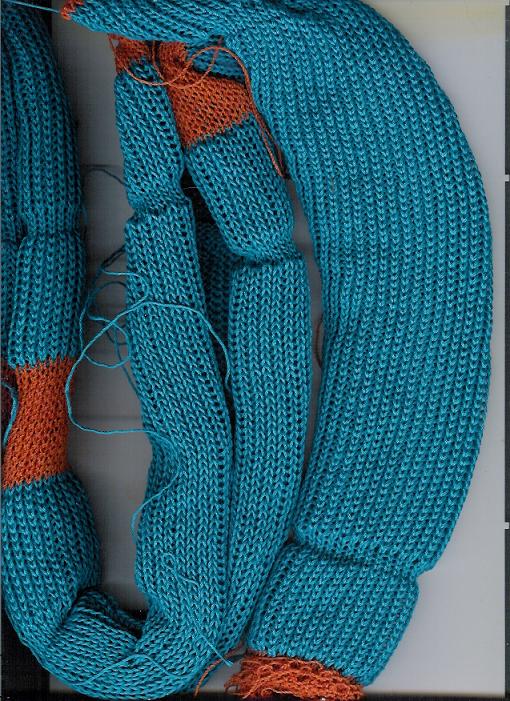
And the snake like tube is what you take to the couch. Cut the dish cloths apart, half way into each band of waste yarn. Then, you watch a good movie whilst crocheting the ends shut (single crochet stitch works fine) with the long end of yarn. Throw away the waste yarn and end up with a whole new bunch of dishcloths that look like this:


I got 10 dishcloths out of this cone. Your mileage will, of course, vary.

Friday, April 1, 2011

Beach Plastic

Normally I restrict (pretty much) my blog to knitting. Specifically machine knitting. But I came across this video and was amazed, sickened, disheartened, fascinated and uplifted by this couple. So I had to share it.

One Plastic Beach from Tess Thackara on Vimeo.

Saturday, March 26, 2011

Elvish Feet


Since winter is hanging on through March it appears, I'm still in the mood to felt slippers. This is another version of Kris Basta's slipper pattern with a couple of twists. I knit 12 rows for the cuff instead of 6 and hung a hem. Makes a nice, sturdy edge. Then I did stripes, changing color every 4 rows. I just carried the yarn up the side without cutting it. Then I made the leaves. Here's how:

Using the same tension as the slippers, ewrap cast on 3 stitches. Knit 10 rows. Hang a hem with first stitches on top of the 3 in work. Knit 2 rows. You'll leave the very center stitch as is. Move one edge stitch out one needle both sides. Pick up the purl bump and hang it on the emptied needle. Knit 2 rows. Move two edge stitches out both sides one needle and fill in with the purl bump. Continue like this, moving one more stitch out than the previous time both sides of the center stitch, filling the emptied needle with purl bumps and knit 2 rows===until you have 15 stitches in work. Knit 4 rows. Take off each leaf and store it on a garter bar or hand knitting needle. Make 6 leaves for each slipper.

Now sew the slipper together. Sew 3 leaves on the front and 3 on the back cuff, spacing them evenly just under the lip of the cuff. You'll have a few more leaf stitches than there are cuff stitches. Every now and then, pick up two leaf stitches to gather them. This will make the leaf point down rather than straight out. I sewed the sides of the bottom of the leaf together so that once felted it looks like a tear drop, no hole evident.


Yes, I do know they're silly. But I like them. Anything to cheer up this endless winter!

Monday, March 21, 2011

Head and Shoulders Knees and Toes, Knees and Toes

Oh no. That's the kids' song. Today's post is about shortrowing heels and toes. I have a little trick for you to remember what to do.

A friend who is a little unfamiliar with short rowing wrote and said she wished there was more information on the slipper pattern as to how to do this. In case it helps someone else, here's how to short-row the heel and toe for Kris Basta's slipper pattern (mentioned in the previous post).

Set the carriage to hold. I use the COLORADO abbreviation to help myself remember what to do. (C standing for carriage side and O standing for opposite side of the carriage.) I had to come up with a mnemonic because I tend to daydream when I knit. Kinda lame, but it works for me. You do the shortrowing carriage side on the way in, making the heel or toe smaller and you do your shaping opposite the carriage on the way out. Remember to put a claw wt each side right where you are short rowing and keep moving them as more needles get put into hold so that the stitches stay firmly in the hooks.

So, you have 27 stitches and the carriage is on the right, you've finished your cuff. Put the end needle closest to carriage in hold, knit across. Put the next end needle closest to the carriage in hold, knit across. (Don't need to wrap anything.) Continue doing this until there are 11 stitches still in work in the center and you have knit across. Now do the Opposite side of the carriage into work, one needle opposite the carriage in the center. Knit across. Put the end needle in the center opposite the carriage into work, knit across. Continue in this manner until all needles are back into work and then do the next section of the slipper. (After the heel you 'll be doing the sole of the foot and after the toe you'll be doing the instep.)

To put needles into work, you can usually just push the needle in so that just the latch and hook of the needle show. But you don't want to drop these stitches because they're really hard to pick up. If you're unsure, just use the one-eyed tool to put the stitch back into work. (Takes a little longer, but less risk of losing it.) I can just push the needle in to make it knit on all my machines except for the little manual plastic Brother 350. The needles have to be all the way back to B position to be in work. No lee-way.

There are more elegant ways of shortrowing heels and toes for socks, but since your stitches get obliterated in the felting process in this slipper pattern, this is a fine way to do it. And easy. Check out how smooth my toes and heels look in the previous post.

Hope I helped someone. Will become automatic and fast if you do it enough times.

Friday, March 18, 2011

Felted Slippers on the Bulky Machine


Once in a while you come upon a great pattern that is zippity quick, simple to make and turns out great. (Rhymes!) Yesterday I knit Kris Basta's Bulky Felted Slipper. You can find the pattern in the files of the Yahoo machine knitting group. Her website is http:KrisKrafter.com/
She sells newly designed garter bars too, if you're interested. It is a great pattern for my recently enhanced Schuss Plus wool "collection". Kris has also given permission for me to use the pattern in our guild's newsletter. We're knitting slippers for the troops and they have to be either acrylic or felted because of the way stuff is washed in the service. A local organization ships them for free for us!

Never ever being content to leave well enough alone, I did make a couple of mods to the pattern. I wanted the heel to ride up a little higher in the back so knit 2 rows before shaping the heel. (Probably didn't make a smidgeon of difference. Could have done more, but they look and feel fine as is.) I knit them at T 10+ on my bulky rather than the T 7 she used. Don't know why other than I always use the largest tension when I'm felting something. It meant that I had to run the washing machine load 3 x to get them to felt way down. I knit 36 rows rather than 40 for the foot. It just looked like it was getting toooooooooooo long, so I kind of panicked. Finally, I seamed them by hand using a stitch that abuts the edges to lie as flat as possible. I believe she seamed hers on the sewing machine. Not huge changes, I'll admit. Next time I might follow her suggestion to pad the foot. I bet they would last longer that way.

Confession---I know better---but I felted them the last time with a white terry towel among other things in the load. It left a lot of linty fibers on the slippers. Crap. I spent some time pulling these off and "shaving" them so they looked new again. Won't repeat that performance any time soon!

Anyway, I think they are super attractive. The style would suit a man or woman I'm thinking.

You can see in the second picture that we still have snow on the bottom deck even though the temps have been in the 50's the last few days. Picture was taken out my craft room window. ugh and aargh.

A scan of the bottom of the slipper:

Thursday, March 17, 2011

Better to make it into a hotpad than eat it!


Stash put to a useful purpose! I have a lot of cotton yarn. Like cones and cones of it. So I made some hotpads with it--like the Christmas ones I did a few months ago. To make sure they would really protect hands from burning, I cut a same sized square of "Insulbrite" and tacked it down in the center before seaming. They turn out fairly thick and substantial. The many long floats actually help with insulation and you don't really have to do anything with them since they're hidden on the inside. After seaming I give them a shot of steam---cotton can take a lot of heat---and this way the floats are set.

I've made several now and the size that seems to work best is 71 stitches x 170 rows on the standard gauge machine. Couldn't tell you the number for the yarn weight but it's a couple of strands of thinnish yarn for each color. I start and end with waste yarn. Remove from machine. Rehang with right side facing me and push to the back of the bed. I bring up the other end and hang in the hooks of the needles. With a straight edge, I push the front stitches through the back and then bind off with the latch tool around the gate pegs. Like in sewing, this puts right sides together and the bottom seam is hidden on the inside. I did a couple of them doing a kitchener stitch closing on the ends, but it took too long. The side seams are mattress stitched after the lining is tacked down.

The internet has some clever kitchen sayings if you care to make some. Just Google "funny sayings" or something like that and you'll get a ton. DAK makes it easy to design and download them. To make them quick to knit, use all capital letters so you don't have to wrap the sides of the words. This one isn't that funny, but belies the Norwegian-American heritage. I have read that this tradition of eating lutefisk and lefse at Christmas came over to this country with the poor (monetarily poor) immigrants and that most people in Norway wouldn't touch lutefisk. In our family, it became a traditional Christmas Eve dinner and you had to have just one bite to make it through the coming year. The lefse is awesome, though. Strangely enough, or maybe to prevent starvation, we also had Swedish meatballs for the Christmas Eve dinner! That lutefisk is awful stuff---like fish jelly---but the butter made up for it a little.

PS For those NOT in the know..."lefse" rhymes with "betcha", both being two syllable words doncha know.