Last night I was knitting away merrily on my 970, making a scarf for a friend. All of a sudden, the carriage froze to the needle bed---almost as if someone had soldered it to the bed. My heart practically sank to the ground. No kidding. No matter what combination of buttons I pushed, that carriage was not going to move. I had 407 rows knit out of 650, fairisle, lots of hand wrapping of long floats. Bah. I did manage to get the scarf off the bed by lifting stitches off the hooks that were frozen in time. Called a friend to see if she would go with me to St. Peter, to Knit and Sew World, to see if Shawn could repair it. She said she would and even called Amanda at her home (Amanda works there) to let her know we were coming in the morning.
It's about a 1 1/2 hour drive (on a clear summer's day) from my house to St. Peter. Miserably cold today with lots of arctic wind, below zero temps. I had some thoughts about maybe this was a foolish thing to do, to drive in this weather, but machine knitters are stubborn, doncha know. I met my friend a half hour from my house and we continued on together. The drive was slow, but not as bad as it could have been. A few cars were in the ditch on both sides of the road. We made it safely.
Shawn dropped what he was doing and worked on my machine for a good 3 1/2 hours. He replaced the timing belt (the cause of things not moving), did a general tune up, blew out mounds of fluff from the inner sanctum, replaced a few doohickys that weren't functioning optimally, cleaned and shined it up and gave it a new coat of oil. My CB1 had a stubborn #1 on its keyboard so I was either avoiding patterns with the number 1 or pressing that button long and hard. He fixed that too. He said my timing belt was getting close to cutting some wires for the electronics and it was good this happened when it did or the repair would have been much more extensive. For all he did, the bill was very reasonable. I would recommend him to anyone. He has tons of Brother and Silver Reed parts and knows both machine brands inside and out. They ship parts all over the world. He even repairs and advises Karen Allen with her mk business. (Karen -the actress in Indiana Jones series who also machine knits.)
Here's the address of Knit and Sew World's website:
http://knitsewworld.com/
When you click on the Knitting Machine tab, you'll find an informative article about a recommended routine for oiling your machine.
Anyway, I'm a very happy camper. Now I just need to unravel some rows and get that scarf rehung on the machine. I have a deadline to meet. Doesn't every machine knitter do gifts at the last minute???
Tuesday, February 1, 2011


Friday, January 21, 2011
Two Machine Knit Ski Headbands Done!

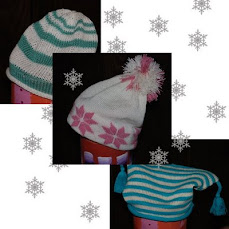
I still have my charity birthday hat resolution going. Knitting the hats every now and then, hoping I'll reach my goal by next December. This is the latest addition to the collection---a really quick knit for a ski or cold weather headband. It's 17 degrees (Fahrenheit) below zero as I type, so anything warm is appealing. Winter hasn't shown any signs of relenting yet.
This was a 15 minute headband! Seriously! I have knit two sizes, but since it goes so quickly, you could adjust for the recipient. Knit rows of 1 x 1 rib, change to Fisherman's rib, then knit more 1 x 1 rib. Machine: Brother Standard gauge with ribber. I used Mary Lou's Symphony yarn, which is no longer manufactured.
Finished sizes: Child 16", Adult 17" unstretched. Knitting is very stretchy but you'd want it snug to stay on!
The basic idea for this headband came from an old (1998) Purls of Joy seminar book, the pattern was written by Karen Hoovestol. I adapted the pattern for my own use, changing the way it is cast on and bound off, also the number of needles used, rows knit and adding a child's size. I'm thinking that even though the pattern is at least 13 years old and a pattern given out for a seminar that I probably should not have given specifics. (Sorry about that. I removed the pattern.) I don't know how to get ahold of Karen to ask permission to use it, so I'm feeling more comfortable just describing it a little. I think you could figure out how to make it and it would be nice if you could make some for charity too.
An aside...Because it's too cold for man or beast, I've been walking inside the house. I do a round trip through living room and kitchen. It's about 40 steps. Am aiming for 20 rounds each day. Not so much, but better than nothing and it warms a body up for a while. How I love winter!
Sunday, January 16, 2011
When Your Knitting Machine Gives You Lemons...
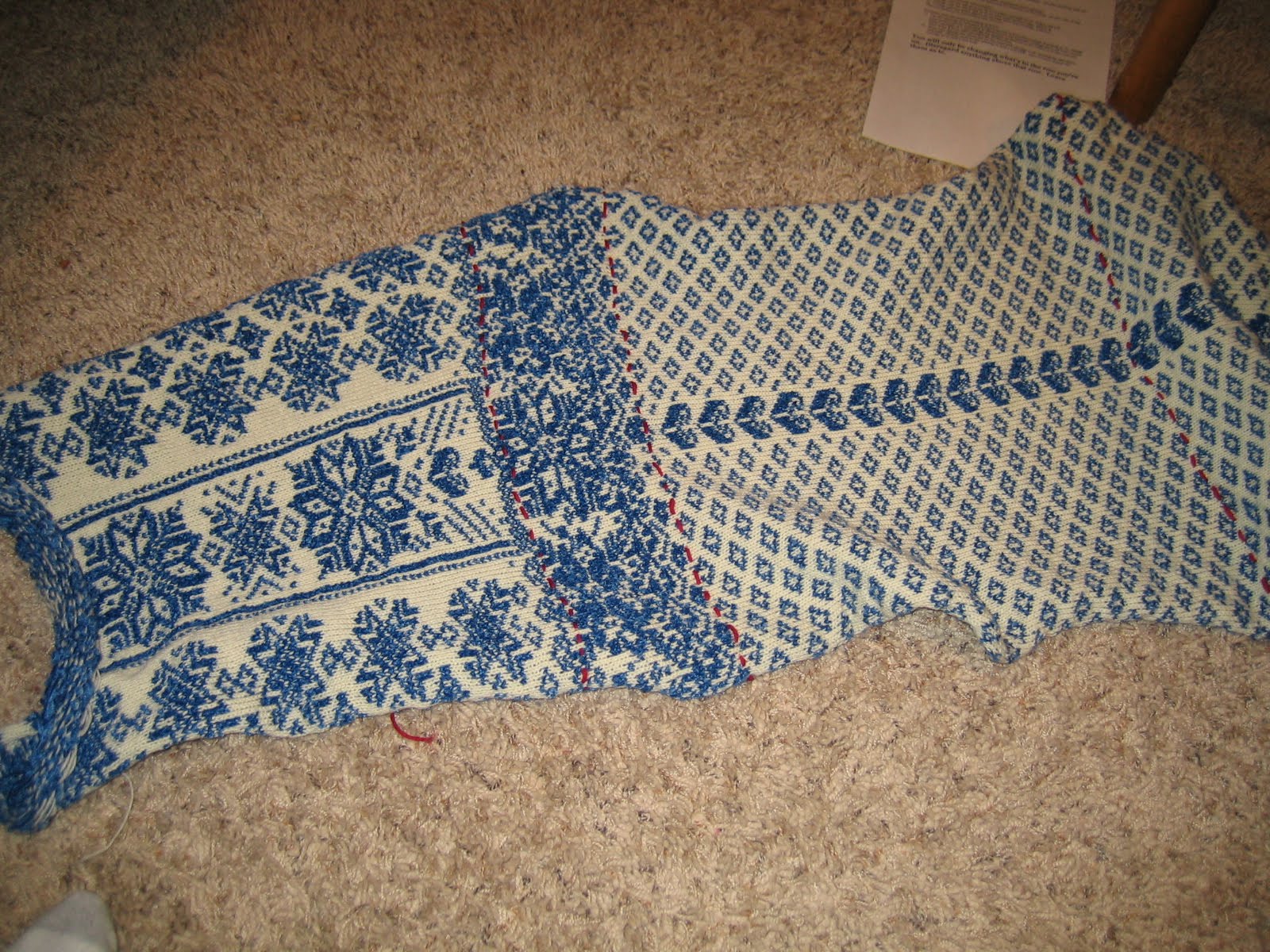
Make a pillow. How lucky was this? I had enough rows to make something out of this ex-scarf, rows that had the correct patterning. First I counted rows and marked off the same number for "front" and "back" with strands of red yarn. If you click on the picture it should enlarge and you will be able to see better where the red yarn markers were stranded through.

Then I stitched across where the red yarn markers were---twice---and surgically removed the messed up snowflakes. Pinned front to back...

With the sewing machine, right sides together, I sewed three sides shut. Turned it right side out, stuffed a pillow in and hand sewed the final seam shut with the main color yarn. Here's the front: And the back...
 Not perfect, but at least it didn't end up in the landfill, nor did an old pillow no longer in service.
My good friend Candace came to my rescue with suggestions as to how to get along better with my SR 860, Silver Link 4 and DAK.
* My pattern of 140 stitches and 578 rows (80,920 stitches) was too large for the system to handle. (My Brother 970 wouldn't have blinked an eye, but o well.) Solution: download and knit a pattern this size in several sections, like 4 or 5.
* Knit really slowly so that the signals have a chance to get through. She said she can actually hear the row changing. Not the click that you hear when you've gone far enough with the carriage, but a different sound. Will have to try to listen for that.
* Turn off any screen saver or virus program that is likely to come on and interrupt.
* Get a laptop with Windows 98, 2000 or XP and use it exclusively with DAK. No internet. (Probably won't happen soon since we have too many computers around the house as it is. Unless I find a really good deal....) 98 is supposed to work the best.
* DAK was designed originally to work with Brothers, so the adaptations for Silver Reeds are not perfect. (Ha.)
* Check out Knitwords 30 and 31 for articles titled "Messing With Matthew" where Mary Anne Oger talks about the Silver Reed systems and DAK. (Matthew would be Matthew Bragg, creator of DAK.)
Thank you, Candace. I really appreciate your help and maybe these suggestions will help someone else.
I think I might need to move on from the 860 for a while. Not fun to have to work so hard on a project, but I guess it was worth something because I learned a bunch.
Then I stitched across where the red yarn markers were---twice---and surgically removed the messed up snowflakes. Pinned front to back...

With the sewing machine, right sides together, I sewed three sides shut. Turned it right side out, stuffed a pillow in and hand sewed the final seam shut with the main color yarn. Here's the front:
 And the back...
 Not perfect, but at least it didn't end up in the landfill, nor did an old pillow no longer in service.
My good friend Candace came to my rescue with suggestions as to how to get along better with my SR 860, Silver Link 4 and DAK.
* My pattern of 140 stitches and 578 rows (80,920 stitches) was too large for the system to handle. (My Brother 970 wouldn't have blinked an eye, but o well.) Solution: download and knit a pattern this size in several sections, like 4 or 5.
* Knit really slowly so that the signals have a chance to get through. She said she can actually hear the row changing. Not the click that you hear when you've gone far enough with the carriage, but a different sound. Will have to try to listen for that.
* Turn off any screen saver or virus program that is likely to come on and interrupt.
* Get a laptop with Windows 98, 2000 or XP and use it exclusively with DAK. No internet. (Probably won't happen soon since we have too many computers around the house as it is. Unless I find a really good deal....) 98 is supposed to work the best.
* DAK was designed originally to work with Brothers, so the adaptations for Silver Reeds are not perfect. (Ha.)
* Check out Knitwords 30 and 31 for articles titled "Messing With Matthew" where Mary Anne Oger talks about the Silver Reed systems and DAK. (Matthew would be Matthew Bragg, creator of DAK.)
Thank you, Candace. I really appreciate your help and maybe these suggestions will help someone else.
I think I might need to move on from the 860 for a while. Not fun to have to work so hard on a project, but I guess it was worth something because I learned a bunch.
Saturday, January 15, 2011
Compulsive, Obsessed, Determined, Crazy, Disappointed and Frustrated
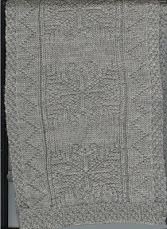
That is an accurate description of my state of mind for the last 24 hours or so. Having knit the little swatch, and having successfully installed all the stuff for the Silver Link and Silver Reed, I thought I was good to go on my Peace scarf. The first couple of hundred rows out of the 586 were good! The chenille even behaved! Pretty, eh?
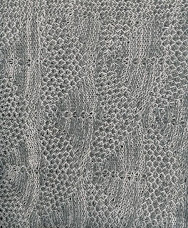
Then, for NO GOOD (or discernable) reason, DAK told me I was going the wrong way with the carriage! So, I pain-stakingly unraveled, did the GO TO RC thing and got going again. But then, it mispatterned all by itself, again for NO GOOD (or discernable) reason and I didn't discover it. Here's the bad: With a detailed pattern, it's hard to see from the backside if things are going ok or not. Well, they weren't going ok, as you can see.
Later, the demonic machine/link decided to shift the pattern over a few stitches, making this mess:
The steam coming out of my ears practically kept the house warm all night. I wrote to my Silver Reed guru friend for help. She said you have to wait for the click at the end of a row so that the next row can be made. (DID that.) Also, you have to knit slowly so that the signals get to the needle bed. (DID that because I also hung the contrast color over the end needle to prevent a hole and that took a couple seconds each row. I guess you have to program in the contrast color in the DAK pattern. If I'm wrong about that, would like some feedback.)
Like I said, I'm stubborn. So I went looking on the Yahoo DAK site for answers. Saw that people were having the same problem with my same setup, but no answers. So then I went to the Softbyte site. The latest update is 7.19.04. I had the previous one. SO, I updated. There were several things that pertained to better functioning of the Silver Reed setup, so I have my fingers crossed that this will be the answer to my problems.
If you are reading this and have the Silver Reed 860 and the Silver Link 4 and have any suggestions, I'd welcome the input with open arms.
I don't know if I have the umph today to try again. So many rows, so much frustration. Maybe I'll cut out the good parts---there seems to be enough length that I can get two pieces from---and make a pillow cover.
 Pretty, eh?
Then, for NO GOOD (or discernable) reason, DAK told me I was going the wrong way with the carriage! So, I pain-stakingly unraveled, did the GO TO RC thing and got going again. But then, it mispatterned all by itself, again for NO GOOD (or discernable) reason and I didn't discover it. Here's the bad:
 With a detailed pattern, it's hard to see from the backside if things are going ok or not. Well, they weren't going ok, as you can see.
Later, the demonic machine/link decided to shift the pattern over a few stitches, making this mess:

The steam coming out of my ears practically kept the house warm all night. I wrote to my Silver Reed guru friend for help. She said you have to wait for the click at the end of a row so that the next row can be made. (DID that.) Also, you have to knit slowly so that the signals get to the needle bed. (DID that because I also hung the contrast color over the end needle to prevent a hole and that took a couple seconds each row. I guess you have to program in the contrast color in the DAK pattern. If I'm wrong about that, would like some feedback.)
Like I said, I'm stubborn. So I went looking on the Yahoo DAK site for answers. Saw that people were having the same problem with my same setup, but no answers. So then I went to the Softbyte site. The latest update is 7.19.04. I had the previous one. SO, I updated. There were several things that pertained to better functioning of the Silver Reed setup, so I have my fingers crossed that this will be the answer to my problems.
If you are reading this and have the Silver Reed 860 and the Silver Link 4 and have any suggestions, I'd welcome the input with open arms.
I don't know if I have the umph today to try again. So many rows, so much frustration. Maybe I'll cut out the good parts---there seems to be enough length that I can get two pieces from---and make a pillow cover.
Friday, January 14, 2011
Fairisle with the Humungus Cone of Chenille Yarn
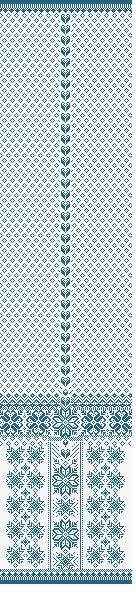
What an afternoon! I decided I would try knitting a scarf with this chenille I'm trying to use up, but do some fairisle. I have the Silver Reed 860 and the Silver Link 4. Still trying to develop a (good) relationship with this machine. Well, I had my pattern done in DAK, a modification of the Dale of Norway Peace design. Thought I'd knit it flat and seam it while watching a movie tonight.  Ha! Got my yarns set up in the 860. Turned on DAK, hit the interactive knitting button. Nada. Nothing. Of course I've only knit a few fairisle things with this machine, last time about a year ago, so I could not remember for the life of me how to do this. I've downloaded to my Brother 970 millions of times and it has always worked so slick for me. After 30 minutes of frustration, I remembered this was not the computer I used when I did get it to knit interactively. That machine died and I had to switch to an extra XP computer we had sitting around here.
For some reason, it popped into my head that there was a driver involved. And it wouldn't have gotten installed on this new/ old computer. So I went hunting in my closet where I keep knitting supplies (the equipment kind) and found the DAK USB Driver. Another 30 minutes have passed. It's on a floppy disk, so I had to also hunt for the removable floppy disk drive. Found that, plugged everything in. For the longest time, nothing happened. Windows tried to install the driver and it said it was unsuccessful. Said the device might not work. Then the driver suddenly installed itself and all was hunky dory. Another 30 minutes have passed. Then the DAK disk said it had to upgrade my hardware. HUH?? I was sure some virus had taken over. But I didn't dare turn things off since it might be legit. It was.
Back in the DAK program, I went to set up for the Silver Reed 860 because it's set for a Brother 970. Believe it or not, the program found an available "virtual" com port all on its own. I guess the USB cables use a "virtual" com port. And I don't even know what I'm talking about. Then it was on to reading the help file. 30 more minutes down the drain. Got enough out of it to go ahead and knit a swatch.
Here it is after hours of fiddling. My 8" wide x 5" tall swatch. Could have knit that by hand 5 times over in the time this all took. But now I think I have it and next time will go more smoothly.
Not being familiar with the knit from screen process and not being comfortable with this machine, I decided I needed to eliminate the plain rows in the pattern so I don't have to switch out the yarns. The design suffers some, but I'm going with it so that I can get it done tonight.
I bet that next time I want to knit with the 970, I'll have to hunt for a new com port to work with that cable.
My, this is a boring post and you're probably thinking I'm one stubborn woman. A lesser woman would have given up by now, yes? My ulterior motive is to have a record of what I did so that next time I have to install this monster, I'll know what I did. If I have success with the scarf, I'll post a picture. So far it isn't biasing or worming. So that's amazingly good.
 Ha! Got my yarns set up in the 860. Turned on DAK, hit the interactive knitting button. Nada. Nothing. Of course I've only knit a few fairisle things with this machine, last time about a year ago, so I could not remember for the life of me how to do this. I've downloaded to my Brother 970 millions of times and it has always worked so slick for me. After 30 minutes of frustration, I remembered this was not the computer I used when I did get it to knit interactively. That machine died and I had to switch to an extra XP computer we had sitting around here.
 For some reason, it popped into my head that there was a driver involved. And it wouldn't have gotten installed on this new/ old computer. So I went hunting in my closet where I keep knitting supplies (the equipment kind) and found the DAK USB Driver. Another 30 minutes have passed. It's on a floppy disk, so I had to also hunt for the removable floppy disk drive. Found that, plugged everything in. For the longest time, nothing happened. Windows tried to install the driver and it said it was unsuccessful. Said the device might not work. Then the driver suddenly installed itself and all was hunky dory. Another 30 minutes have passed. Then the DAK disk said it had to upgrade my hardware. HUH?? I was sure some virus had taken over. But I didn't dare turn things off since it might be legit. It was.
Back in the DAK program, I went to set up for the Silver Reed 860 because it's set for a Brother 970. Believe it or not, the program found an available "virtual" com port all on its own. I guess the USB cables use a "virtual" com port. And I don't even know what I'm talking about. Then it was on to reading the help file. 30 more minutes down the drain. Got enough out of it to go ahead and knit a swatch.
Here it is after hours of fiddling. My 8" wide x 5" tall swatch. Could have knit that by hand 5 times over in the time this all took. But now I think I have it and next time will go more smoothly.

Not being familiar with the knit from screen process and not being comfortable with this machine, I decided I needed to eliminate the plain rows in the pattern so I don't have to switch out the yarns. The design suffers some, but I'm going with it so that I can get it done tonight.
I bet that next time I want to knit with the 970, I'll have to hunt for a new com port to work with that cable.
My, this is a boring post and you're probably thinking I'm one stubborn woman. A lesser woman would have given up by now, yes? My ulterior motive is to have a record of what I did so that next time I have to install this monster, I'll know what I did. If I have success with the scarf, I'll post a picture. So far it isn't biasing or worming. So that's amazingly good.
Thursday, January 13, 2011
Look Ma! No worms! (A machine knit chenille success)

Thought I would try to make a fru fru scarf with my giganticus cone of chenille. It (the little swatch) turned out quite awful. All the loops wormed. Now, that wouldn't have been so bad if all the loops wormed the same way, but they didn't and the result was that it just looked like a wet mop. A well-used wet mop at that.
So, I decided to try knitting a scarf in rib, the only thing I've had success with using this yarn. In case you also have a 20 lb cone of the stuff and don't yet have the nerve to place it in a landfill, you might try my scarf. Here are the directions:
Machine: Silver Reed 860 with ribber
Yarn: Chenille approx. 16 ounces + serger thread (6,000 yard cone will make 3-4 scarves)
Tension: English rib ( kK1P1 rib or Double Rib by tucking the stitches on every other row on the ribber side) 4.6 st x 9 rows = 1” at T2/2
Finished size: 10.5 “ wide x 78” (6.5 feet) long
Notes:
• Odd as it may seem, the lower tension works better with the chenille. The carriage is easier to push and it helps prevent “worming”.
• The serger thread also helps prevent the “worming” but you can’t really see it, which is a good thing.
• Even though I used a lot of weight I yanked the knitting down every couple of rows for the first 50 rows. But after that, it knit smoothly.
• I’m not laundering this--- don’t want to take the chance that it will fall apart!
• You may need to weave in the two ends with a crochet hook. When I tried an embroidery, large-eyed needle, the yarn shredded.

DIRECTIONS
Thread serger thread through one eyelet on the mast and the chenille through the other. Circular cast on as per manual – Racking handle on P 4. R/R for circular cast on. Change to T 2/2 for scarf . Hang lots of weight and move the weights up every 50 rows. (I used 5 of the larger ribber weights!) Knit to RC 700. Change to tension 10/10, change settings to regular rib and knit one row to the left. Transfer ribber stitches to the main bed. Chain cast off including the serger thread. Weave in ends.
These same directions would work with other yarn---it was just a relief to have something turn out with this wily chenille. It's been a couple of hours now, and NO WORMING!! I might even be able to wear this thing. Such a pretty color! Such a weird "hand".
Tuesday, January 11, 2011
Fru Frueyness Scarf - a free machine knit pattern

Had a request to post the directions for a loopy fru fru scarf. It was on my blog at one time, but I must have deleted it. Be forewarned, it's not a fast knit, but it's kind of fun - if you like doing odd things on the machine like I do. You need some interesting yarn. This is made of one or two balls of ribbon yarn. It has some nice colors. Can't remember where I bought it, but most yarn shops have such a yarn. Most people have that one odd (expensive so you could only buy one, but it was irresistable) skein of yarn that was an impulse purchase and it sits in the closet not knowing what to do with itself. This project is ideal for such an orphan.
Some yarns will make a more decorative accessory; some will make a serviceable and warm scarf. It just occurred to me that I might use yarn from that giant cone of chenille to make the loops. Hmmmm......... as long as it never gets laundered, might work. Anyway, on to the instructions as to how to make this wonder of the knitting world.
DIRECTIONS
This fru fru-ness can be made on any machine. You need one hand knitting needle, a large one is preferable because it's easy to hang onto, but any will do. My first attempt was using the gate pegs of the ribber to do the loops, but I didn't like it as much as using a knitting needle because some splitting occurred on the sharp gate pegs and unless I wrapped the yarn really loosely, it was hard to pull the loops off the gate pegs. Also, the loops didn't get very long because even at the lowest position the distance from the main bed wasn't so great. For the main yarn choose a matching or coordinating color, a fairly thin yarn, any type, as many ounces as you want the scarf to be wide and whatever length will accommodate the novelty yarn length. How's that for helpful, precise information? (It’s best to have the main yarn be thin so that the scarf doesn’t get too heavy.) The tension you use on your machine needs to be loose enough to knit both the main and novelty yarns together. I used the largest T on the standard machine for the one pictured.
Here's the basic moves:
This is one of those things that is harder to describe than to do. Ewrap with main yarn over 7 or more needles. Knit 2 rows and hang a weight. Basically you are making use of the hand knitting needle to create loops that are of equal size and they are woven into a strip by wrapping the novelty yarn over the main bed needles. Position the hand knitting needle the same distance from the main bed each time it is used. The distance below the main bed that you position the needle horizontally will determine the length of the loops. Hang onto the knitting needle with your left hand, wrap the yarn and do the carriage with your right hand. Put the weaving brushes into work if your machine has them. You will wind over every other top N and down under the knitting needle, repeating across every other main bed needle.
Each row push out to E position the N that you are going to hang novelty yarn over to make it easier to wrap. You don’t have to e-wrap the main bed needles, just loop the yarn around. After winding across the needle bed, hang on to the end of the novelty yarn with one hand and push the carriage across with the other. Then remove the knitting needle and repeat but use the opposite main bed needles, every other one. You'll be knitting and wrapping in the opposite direction because the carriage will be on the other side, of course.
When the carriage is on the right, ready to knit, the hand knitting needle will have the empty point facing right. When the carriage is on the left, ready to knit, the hand knitting needle will have the point facing left. This way you can use the point to pick up the yarn more easily and pull it off the loops more easily. This will make more sense to you when you get going.
The drawing below shows you how to wind the yarn. You don’t need to use your row counter, unless you want a repeat performance in the future. You can just merrily knit until you run out of novelty yarn. Check occasionally to make sure the yarn isn’t caught up on the gate pegs.

Here's a closeup of the stitches. I think I used 7 main bed stitches for this scarf.

Subscribe to:
Posts (Atom)


 Posts
Posts