machine knitting midgauge standard bulky machknit knit machine-knit patterns

Thursday, January 13, 2011

Look Ma! No worms! (A machine knit chenille success)


Thought I would try to make a fru fru scarf with my giganticus cone of chenille. It (the little swatch) turned out quite awful. All the loops wormed. Now, that wouldn't have been so bad if all the loops wormed the same way, but they didn't and the result was that it just looked like a wet mop. A well-used wet mop at that.

So, I decided to try knitting a scarf in rib, the only thing I've had success with using this yarn. In case you also have a 20 lb cone of the stuff and don't yet have the nerve to place it in a landfill, you might try my scarf. Here are the directions:
Machine: Silver Reed 860 with ribber
Yarn: Chenille approx. 16 ounces + serger thread (6,000 yard cone will make 3-4 scarves)
Tension: English rib ( kK1P1 rib or Double Rib by tucking the stitches on every other row on the ribber side) 4.6 st x 9 rows = 1” at T2/2
Finished size: 10.5 “ wide x 78” (6.5 feet) long
Notes:
• Odd as it may seem, the lower tension works better with the chenille. The carriage is easier to push and it helps prevent “worming”.
• The serger thread also helps prevent the “worming” but you can’t really see it, which is a good thing.
• Even though I used a lot of weight I yanked the knitting down every couple of rows for the first 50 rows. But after that, it knit smoothly.
• I’m not laundering this--- don’t want to take the chance that it will fall apart!
• You may need to weave in the two ends with a crochet hook. When I tried an embroidery, large-eyed needle, the yarn shredded.


DIRECTIONS
Thread serger thread through one eyelet on the mast and the chenille through the other. Circular cast on as per manual – Racking handle on P 4. R/R for circular cast on. Change to T 2/2 for scarf . Hang lots of weight and move the weights up every 50 rows. (I used 5 of the larger ribber weights!) Knit to RC 700. Change to tension 10/10, change settings to regular rib and knit one row to the left. Transfer ribber stitches to the main bed. Chain cast off including the serger thread. Weave in ends.

These same directions would work with other yarn---it was just a relief to have something turn out with this wily chenille. It's been a couple of hours now, and NO WORMING!! I might even be able to wear this thing. Such a pretty color! Such a weird "hand".

Tuesday, January 11, 2011

Fru Frueyness Scarf - a free machine knit pattern


Had a request to post the directions for a loopy fru fru scarf. It was on my blog at one time, but I must have deleted it. Be forewarned, it's not a fast knit, but it's kind of fun - if you like doing odd things on the machine like I do. You need some interesting yarn. This is made of one or two balls of ribbon yarn. It has some nice colors. Can't remember where I bought it, but most yarn shops have such a yarn. Most people have that one odd (expensive so you could only buy one, but it was irresistable) skein of yarn that was an impulse purchase and it sits in the closet not knowing what to do with itself. This project is ideal for such an orphan.

Some yarns will make a more decorative accessory; some will make a serviceable and warm scarf. It just occurred to me that I might use yarn from that giant cone of chenille to make the loops. Hmmmm......... as long as it never gets laundered, might work. Anyway, on to the instructions as to how to make this wonder of the knitting world.

DIRECTIONS
This fru fru-ness can be made on any machine. You need one hand knitting needle, a large one is preferable because it's easy to hang onto, but any will do. My first attempt was using the gate pegs of the ribber to do the loops, but I didn't like it as much as using a knitting needle because some splitting occurred on the sharp gate pegs and unless I wrapped the yarn really loosely, it was hard to pull the loops off the gate pegs. Also, the loops didn't get very long because even at the lowest position the distance from the main bed wasn't so great. For the main yarn choose a matching or coordinating color, a fairly thin yarn, any type, as many ounces as you want the scarf to be wide and whatever length will accommodate the novelty yarn length. How's that for helpful, precise information? (It’s best to have the main yarn be thin so that the scarf doesn’t get too heavy.) The tension you use on your machine needs to be loose enough to knit both the main and novelty yarns together. I used the largest T on the standard machine for the one pictured.

Here's the basic moves:
This is one of those things that is harder to describe than to do. Ewrap with main yarn over 7 or more needles. Knit 2 rows and hang a weight. Basically you are making use of the hand knitting needle to create loops that are of equal size and they are woven into a strip by wrapping the novelty yarn over the main bed needles. Position the hand knitting needle the same distance from the main bed each time it is used. The distance below the main bed that you position the needle horizontally will determine the length of the loops. Hang onto the knitting needle with your left hand, wrap the yarn and do the carriage with your right hand. Put the weaving brushes into work if your machine has them. You will wind over every other top N and down under the knitting needle, repeating across every other main bed needle.

Each row push out to E position the N that you are going to hang novelty yarn over to make it easier to wrap. You don’t have to e-wrap the main bed needles, just loop the yarn around. After winding across the needle bed, hang on to the end of the novelty yarn with one hand and push the carriage across with the other. Then remove the knitting needle and repeat but use the opposite main bed needles, every other one. You'll be knitting and wrapping in the opposite direction because the carriage will be on the other side, of course.

When the carriage is on the right, ready to knit, the hand knitting needle will have the empty point facing right. When the carriage is on the left, ready to knit, the hand knitting needle will have the point facing left. This way you can use the point to pick up the yarn more easily and pull it off the loops more easily. This will make more sense to you when you get going.

The drawing below shows you how to wind the yarn. You don’t need to use your row counter, unless you want a repeat performance in the future. You can just merrily knit until you run out of novelty yarn. Check occasionally to make sure the yarn isn’t caught up on the gate pegs.

Here's a closeup of the stitches. I think I used 7 main bed stitches for this scarf.

Thursday, January 6, 2011

Machine Knit California Footies- free pattern


Who knew California could be so cold? I had some bulky boucle' yarn (acrylic) in my stash so decided to make my daughter some more footies to get her through the winter. The scans don't do them justice----they're really fluffy in person. Sorry, I lost the labels, but I'm pretty sure they were either Lion or Bernat brand. Probably purchased at JoAnn's or Michaels. If you'd like to try them, here's what I did for a size 6 women's foot. You would need to add/subtract stitches and rows for different sizes. They are super simple, from start to finish took about an hour. I used the purl side as the right side because the top cuff rolls slightly to the outside and the texture of the yarn hides the side seam. A little hard to seam with this yarn but when you do seam, the stitches nicely disappear. If you find it impossible because it breaks, use a matching color of smooth acrylic yarn and pull the seams tighter than normal so it disappears. 100% acrylic should not shrink in washer or dryer.
Machine: Bulky
Gauge: 3 st and 4 rows to one inch, T6
Yarn: Bulky boucle', just a few ounces main and contrast colors. One skein of each color should make a couple of pairs of footies.
Directions: Cast on 32 stitches at T6, a few rows WY and 1 row ravel cord. Leave a 12” yarn tail for seaming. With Main yarn K6 R, transfer every other st to neighbor for a picot edge. Leave empty N in work. K 6 R , hang hem from first row. T10 K 1 R to seal hem.
Ankle: T6 K 5 R.
Heel: Set lever(s) on carriage to HOLD. Push all N left of zero all the way out. Short row down to 6 st and back out until all N are in work. (Pull out a needle closest to the carriage, knit across. No need to wrap. Repeat. Then knitting back in, put needle opposite the carriage back to work, knit to the other side. Repeat.) Pick up heel of adjacent stitch to prevent hole both sides.
Foot: K 20R.
Toe: Exactly like heel. Pick up heel of adjacent stitch to prevent hole both sides. Set carriage to N both sides.
Knit 1 Row over all. Take stitches off on waste yarn.
Finishing: Kitchener st the toe from the purl side and seam the side as flat as you can manage. Remove the ravel cord and waste yarn.
Knit the other footie holding stitches on the opposite side. To have the carriage at the other side, K 6 Rows for the ankle.TIE: Ewrap over 3 N. T6, Knit 150 Rows, BO.
Thread through the hem beginning and ending at front. Cinch if desired, tie bow. At first I thought I wanted an I cord for the tie, but it was a big bother knitting an I cord with this yarn. It kept getting stuck on gatepegs or dropping stitches. Doing 3 stitches in a plain stockinette was fine because it ends up looking like an I cord anyway. The tie is decorative, but also if the ankle of the footie is too loose, this will help them stay on.

Hope I've given you enough info to try a pair. Often it's a matter of knitting one and then adjusting stitches and rows to suit.

Monday, January 3, 2011

First Machine Knit of 2011


I have some lovely Noro Kureyon in my stash and decided to make some of Midnattsol's slippers with it. You can see the pattern on her blog: http://hurpeknagg.blogspot.com/
Her pattern is for hand knitting, but since it's just a strip of rectangles, it's easily (and really quickly) done on the machine. I love the colors of Noro and they slide into one another even more deliciously when you felt the yarn. I used: Silver Reed midgauge, T10+, two skeins of Noro Kureyon, one for each slipper. Each rectangle was 24 stitches x 32 rows. These fit a women's size 9 American with socks on. Since I had to run the slippers through the wash four times to get it them to felt down small enough, if I were to make them again I'd do 22 stitches x 30 rows, or even a bit smaller.


Some hints if you want to make these slippers with this yarn: Noro is really "sticky" when used on a knitting machine so a lot of weight is required. Since each rectangle is not distinguishable from the next, run a strand of red yarn through the stitches after each rectangle is knit so you know where to sew the rectangles together. Unless you are a genius at origami, you should use 7 different colored yarn markers in the spots specified in the pattern to aid in sewing up. Finally, use a seaming technique that butts the rectangles together with a really flat seam. Doesn't even matter if it is beautiful. What matters is that it is flat so that when it felts, there isn't a bunched up seam. Pull out the red yarn at the very end of seaming. One thing I did which varies from the pattern is that I crocheted a single crochet row around the opening (after seaming is done) and then did a second row of backward crochet, also called a crab stitch. I thought it would add some stability to the cuff, but it wasn't really necessary.

This is the sole of the slipper. I kind of wish these colors were topmost, but it's almost impossible to predict.

I'm wearing them as I type. It's 11 degrees F outside and I'm toasty inside. I still have 4 skeins to use up. I think I'll knit a cowl but won't felt it. Stay tuned!

Friday, December 31, 2010

Machine Knit Puppy Sweater

Well, I guess this is the last post of the year. I have knit a lot of stuff in 2010! I wonder if I'll match the amount in 2011. I suspect so---the addiction shows no signs of waning. Anyway, to my readers I wish you a Happy New Year!

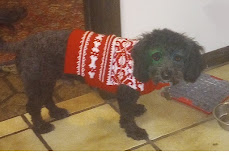
We spent Christmas with our daughter in California. We were hoping to get some sun and warmth, but the weather was pretty awful. Her new puppy was shivering in the cold the whole time we were there, so I thought I'd knit him a sweater. The dimensions are hard to figure out even with measurements. She'll just have to try it and let me know what needs to be adjusted. The pattern is from the Caron website---called the Rainbow Pooch Sweater. You can find it at http://www.caron.com/projects/br/rainbow_pooch.html

It's a hand knitting pattern that I found easy to translate to machine knitting. I made the smallest size on my Silver Reed 860 midgauge with a single strand of Simply Soft. I followed the pattern fairly faithfully. Viewed from the side:
And, also viewed from tummy side
Oliver is a miniature dachshund. Cute as a button and full of personality. Never thought I'd knit a sweater for a dog, but there it is.

On to other things in 2011. That's going to be hard to get used to saying. Always seems to be the case...

Monday, December 20, 2010

Machine Knit UFO morphing to FO


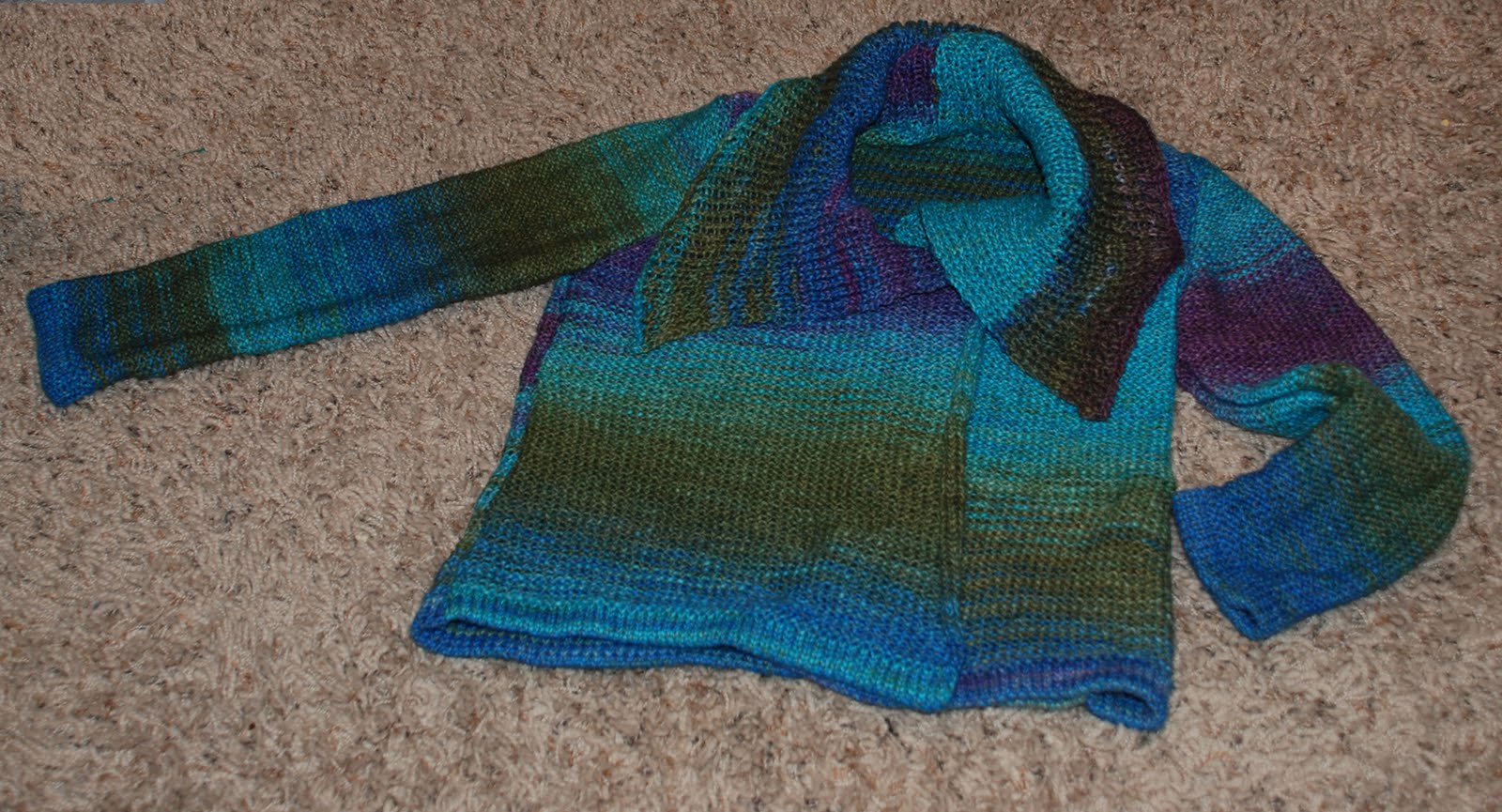
Those who know me are aware of the fact that UFO's (unfinished objects, not the alien types) don't sit well with me. Can't stand to have something in the closet that isn't finished. This one has to be a record for me having sat around for 2+ months. I started this at a machine knitting retreat in October, wasn't sure I liked it, then decided yesterday to finish it. All I had left to do was the wide shawl collar. Easy enough for a machine with a ribber.


The pattern is "Kyra", a free pattern obtainable on the Berroco website. It was easy to convert from hand knitting to machine knitting. I changed the cuffs and bottom hem to Mary Anne Oger's stockinette, no- roll hem, which I love. It's a little hard to see because of the variegation in the yarn. I also love the asymmetrical aspect of this sweater, the shaping at the sides and the huge shawl collar, which I had to knit in two sections in order to have enough stitches.


I knit it on my Silver Reed 860 midgauge with ribber (the ribber was needed only for the collar). The rib isn't exactly like the rib in the pattern. A person could knit the sweater on the machine and then knit the collar by hand, but I don't have that much patience. Actually, I have to say the 860 does make nice ribbing. The yarn is Conshohocken cotton (lovely soft stuff) that I hand dyed. I knit up 3 large blanks and painted them with Dylon in wide swaths so the color repeats would be long. I machine washed and dried the blanks so all the shrinking is done. Some people think this is a lot of work, but the fact that the garment won't shrink appreciably is worth it to me. I unwound the blanks into balls and knit from there. I didn't make any attempt to match up fronts with the back and didn't try to make the sleeves match either. Artistic license, I guess.

It's for my daughter. Don't know if she'll like it at all, whether it will fit her or how the closure should go. Guess I'll just have to wait a week or so.

Saturday, December 18, 2010

Machine Knit Christmas Idea


Wanting some little extra Christmas items, I decided to make some table protectors/ hotpads/ trivet kind of things. I have a boat load of cotton yarn, so there is plenty of pretty red and white to use up. I used DesignaKnit to borrow motifs from various patterns I've stored. Mostly Dale of Norway Norwegian sweater hand knitting patterns that I've purchased. Any 24 stitch punch card or other electronic pattern could be used. Mine ended up to be about 8" x 8" give or take. You'd have to experiment a little with your yarn, if you want to try making some. I'm just partial to all things Norwegian, hence the Nordic look. And, can you tell that red is my favorite color????

They all are made of 3 strands of 16/2 cotton each color and my Brother 970 standard gauge electronic to which the patterns are downloaded. They are all close to 73 st wide x 91 rows long (182 doubled) to make a square. Different yarn would need to be experimented with (swatched) to produce a more or less square hotpad.
I started and ended with waste yarn, then the main pattern. The pattern is repeated twice lengthwise, folded and (off the machine) kitchener stitched together from the purl side so that both ends look pretty much the same. Turn the thing right side out and then sides are mattress stitched closed. I added a 50 row I cord to one corner just in case a person would want to hang one on the handle of an oven.

They seem to be pretty heat-resistant, but for extra protection a good idea is to put a square of heat resistant fabric in the middle before seaming it shut. (I can't remember what that stuff is called, but it has some metal like fabric with mesh on both sides. Quilted ThermaFlec Heat Resistant Fabric??? Something like that. )

It has been the perfect mindless project for me after knitting 29 ski hats and headbands for a local high school ski team. Am I ever glad that's done. Here's the hat, guys' headband and girls' headband. The school's logo includes an anchor since Minnetonka is a huge local lake. The suburb is named Minnetonka, as is the high school. I think the lake came first then the town, but I'm not sure. Anyway, knitting for profit rather than fun takes the joy out of it....until next year. The team mom promised a picture of the kids. Hope she remembers.

By any chance, did you notice that I've knit almost 20 miles worth of yarn this year? It's probablly more, because I forgot to record some of the things I knit. Pretty impressed with myself!